Read the new article
Keep Aseptic Conditions Continuity within Transfer Procedures
A Smart CCS:
Talking about the advantages in CSS with an evolved approach on new Annex 1 thanks to De Lama Magnetodoor®, the futuristic magnetic driven door, and HyPerPure® cold sterilization technology with H202 under deep vacuum.
PREVIEW:
The transfer of sterile materials within the aseptic processes remains a thorny point to address and requires robust risk assessment and risk management within a comprehensive contamination control strategy (CCS).
As well emphasized in EU GMP Annex 1: Manufacture of Sterile Medicinal Products and in §4.10 of the World Health Organization Annex 2: WHO Good Manufacturing Practices for Sterile Pharmaceutical Products, “The transfer of equipment and materials into and out of the cleanrooms and critical zones is one of the greatest potential sources of contamination” (1,2).
All the essential manual practices involved require a punctual consideration of all potential risks related to contamination protection. That includes procedures, training, validation and controls, as well as the potential contribution to the particulate contamination of the protective materials.
Class/ISO 5 maintenance and continuity is an important point of aseptic production. As these guidelines clearly state, « …Where possible, items should be sterilized and passed into these areas through double-ended sterilizers [§4.11]. The use of rapid transfer port technology should also be considered” [§8.47] (1,2).
Implementation of best practices in contamination control is the best approach for materials transfer. A combined set of technological solutions aimed to avoid all critical steps by using a smart design to achieve more efficient control of the contamination within the CCS is paramount.
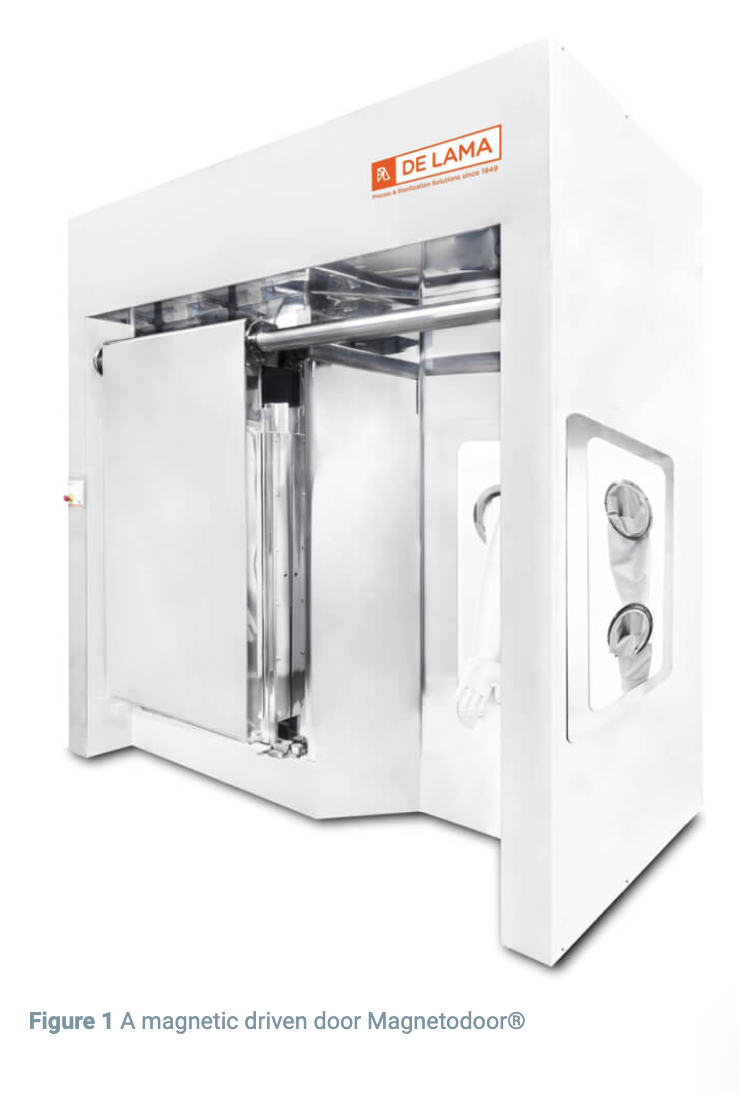
An interesting example is direct transfer by a magnetic-driven door (e.g., Magnetodoor®) designed and created to provide a direct connection with an isolator, as shown in Figure 1. It is a special sliding door which, compared to conventional doors that require wheels, toothed belts and other mechanisms, does not release any particles due to its different design.
This magnetic-driven door does not have any hidden points, which represent a typical criticality for cleaning, and allows a minimization of the space and spare mechanical parts needed compared to a conventional door with a swing-and-book opening movement. In such a way, the prevention of potential contamination during the transfer is ensured by design, creating a direct and integral connection between a sterilizer and/or combined washer and sterilizer units and the isolator.
This configuration not only manages risks but, where possible, eliminates them. This looks like a good approach, considering the introduction of the European Medicines Agency Guideline on the Sterilization of the Medicinal Product, Active Substance, Excipient and Primary Container: “Sterility cannot be assured by testing; it needs to be assured by the use of a suitably designed, validated and controlled manufacturing process” (3).
READ THE FULL ARTICLE ON PDA PORTAL:
https://www.pda.org/pda-letter-portal/home/full-article/how-to-keep-aseptic-conditions-continuity-within-transfer-procedures