Sterilization Process: How It Works and Which Method to Choose
Ensuring the complete absence of microorganisms on instruments, materials and products is a critical requirement across many industries: pharmaceutical, biomedical, medical devices, cosmetic and food. The sterilization process is the procedure that makes this possible, and it represents one of the cornerstones of public health and product quality worldwide. In this article we look at what sterilization is, what its key steps are, the main methods used in industry, and the criteria for choosing the right approach.
What is the sterilization process?
Sterilization is a controlled process whose goal is to eliminate every form of microbial life, including viruses, bacteria, fungi and spores, from an object, a surface or a fluid. Unlike other microbiological treatments, it must guarantee a measurable and repeatable level of safety, validated through biological indicators, chemical indicators and physical parameters.
What does “sterile” mean?
From a technical standpoint, sterilization is the set of operations, physical, chemical, or a combination of both, that brings an object to a “sterile” state. The meaning of the term goes well beyond a simple reduction in microbial load: it implies the total, validated and documented elimination of any viable microorganism, including the most resistant forms such as bacterial spores. However, since the concept of “absolute” cannot be applied in this field, “total elimination” is in reality defined as an infinitesimal probability, which for terminally sterilized pharmaceutical products and medical devices is set at 10⁻⁶: a one-in-a-million chance that a microorganism survives. This value is known as the SAL (Sterility Assurance Level) and represents the universally accepted benchmark for validated sterilization processes.
Disinfection vs sterilization: what’s the difference?
Understanding the difference between disinfection and sterilization is essential to selecting the right procedure. Disinfection reduces the microbial load to levels considered safe, but does not necessarily eliminate spores and does not guarantee a measurable level of sterility. Sterilization, on the other hand, aims at the complete elimination of microorganisms and is validated through biological indicators, chemical indicators and physical parameters. In practical terms, a disinfected surface is “clean” from a microbiological standpoint; a sterilized object is free of any microbial life.
What is the first step in the sterilization process?
An effective sterilization process is not limited to the treatment itself: it unfolds across several sequential phases. The first phase, often underestimated, is the most critical one for the success of the entire cycle.
Cleaning and preparation
Cleaning is today considered one of the fundamental preliminary phases, especially when residues, organic or inorganic, may be present, often related to previous manufacturing steps. Without thorough cleaning, the sterilizing agent simply cannot reach all surfaces, and the cycle is doomed to fail. This phase includes the mechanical removal of organic and inorganic residues from instruments and components.
Driven by the latest Cleaning Validation guidelines (FDA, EMA, USP <1072>), cleaning is progressively moving from manual to automated processes, in order to guarantee efficacy and repeatability. To this end, De Lama offers a wide range of innovative and customizable solutions for cGMP pharmaceutical washers and applications across related industries.
Packaging and material handling
In most cases, items are then placed in pouches, containers or packaging materials compatible with the chosen sterilization method, so that sterility is maintained even after extraction from the sterilizer and until the moment of use. The sterilization cycle itself follows: application of the sterilizing agent (heat, steam, gas, radiation) according to validated parameters of time, temperature, pressure and concentration. Finally, sterilized products are stored in controlled environments, and each cycle is documented to ensure full traceability and batch release.
What are the main sterilization methods used in industry?
The sterilization methods available today are diverse, and the choice depends on the nature of the material, its heat sensitivity, the type of packaging, and the applicable regulatory requirements.
Steam sterilization process (autoclave sterilization) and heat processes
Steam sterilization, commonly referred to as autoclave sterilization, is the most widely used and effective method for heat-resistant materials. A steam sterilizer uses saturated pressurized steam, typically at 121 °C (250 °F) or 134 °C (273 °F), to denature the proteins of microorganisms. It is the reference method for surgical instruments, glass containers, pharmaceutical liquids and industrial process components. Its main advantages are speed, the absence of toxic residues, and low operating costs.
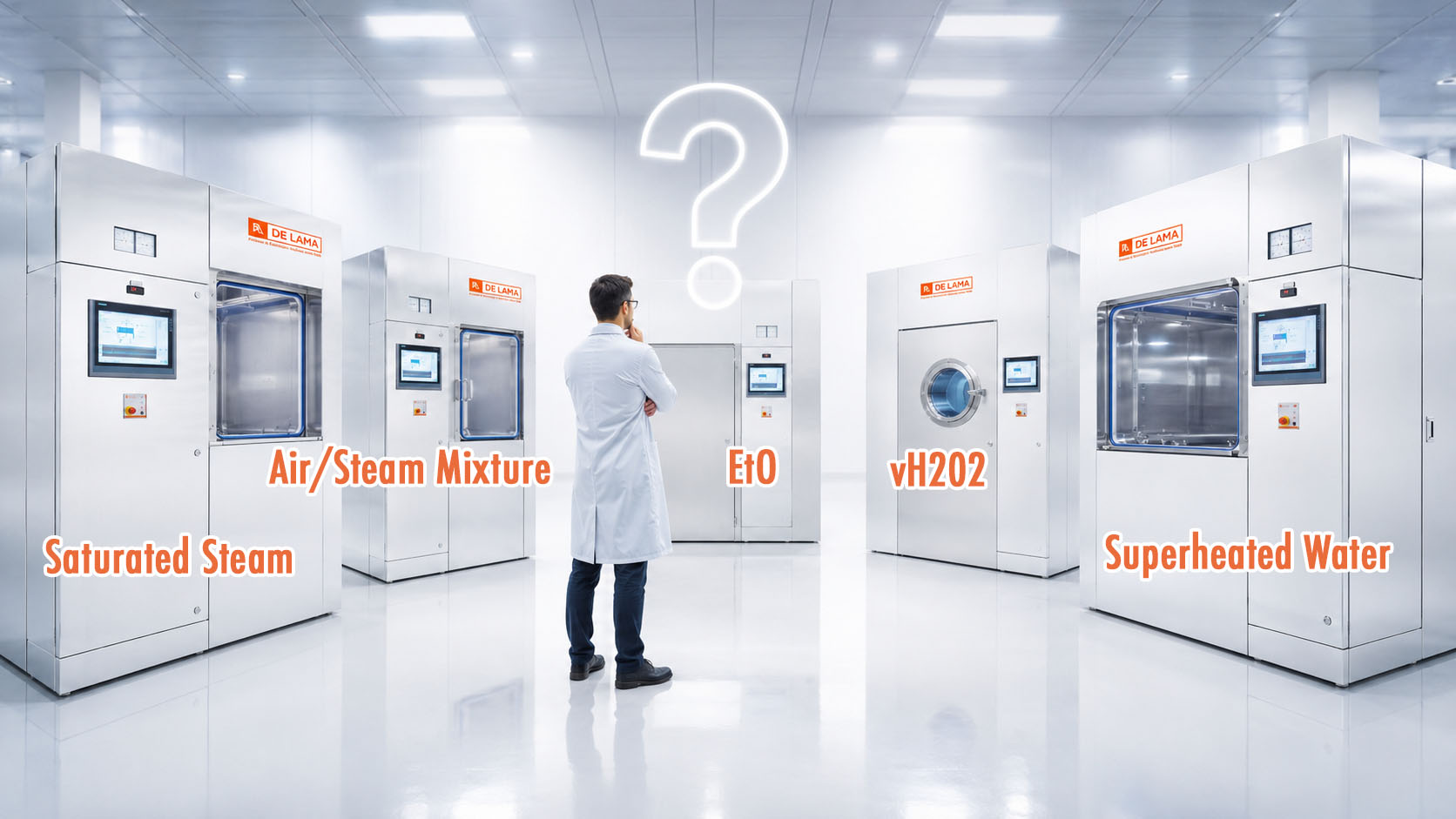
Within this broader category of heat-based sterilization, De Lama’s portfolio includes several variants, some using steam (with or without air mixture), others using superheated water or hot air:
‣ Saturated steam sterilization: the classic, most widely used and best-known method. After air removal, water vapor is used to bring the load and every cavity to a defined temperature, maintained for a specific time at a given pressure. The temperature commonly used is 121 °C (250 °F), held for the time required to achieve microbial inactivation as defined by validation.
‣ Air-steam mixture sterilization: used for products that require a counter-pressure during the cycle, such as pre-filled syringes (to keep the plunger from moving) or deformable products like SVP (Small Volume Parenteral) and LVP (Large Volume Parenteral) containers.
‣ Dry heat sterilization (in ovens): effective for powders, oils and glassware. It is also the method of choice to achieve depyrogenation (at temperatures above 250 °C / 482 °F), particularly required in pharmaceutical applications to eliminate pyrogens from glassware.
Ethylene oxide (EtO) sterilization is a low-temperature chemical method widely used in the medical device industry. It is the standard for single-use plastic devices, complex assemblies, electronics and heat-sensitive products that cannot withstand steam sterilization. EtO penetrates packaging materials and complex geometries effectively, but the process requires long cycle times (including aeration phases) and dedicated facilities to safely manage a flammable and carcinogenic gas.
In the United States, EtO sterilization is regulated by the FDA and the EPA, with growing pressure to reduce emissions and adopt alternative technologies. The FDA’s Ethylene Oxide Sterilization Master File Pilot Program and the agency’s broader efforts to advance alternatives have accelerated interest in low-temperature methods such as vH₂O₂.
Hydrogen peroxide sterilization process (vH2O2)
The hydrogen peroxide sterilization process (vH₂O₂, vaporized hydrogen peroxide) is part of the low-temperature sterilization family, but it deserves special consideration as it is a rapidly growing technology, especially in pharmaceutical, biotech and medical device sectors. It uses H₂O₂ vapor at low temperature to achieve fast, eco-friendly sterilization: the peroxide breaks down into water and oxygen, leaving no toxic residues. It is ideal for isolators, cleanrooms, transfer systems (pass-boxes) and heat-sensitive products.
De Lama’s vH₂O₂ HyPerPure® sterilization, in particular, operates under deep vacuum, allowing it to sterilize not only surfaces (where, in applications such as isolators and pass-boxes, the correct term is surface sterilization or, more accurately, decontamination) but also to reach every point of the load, even in the presence of complex geometries, cavities and undercuts. The technology can also penetrate multiple layers of Tyvek® or medical-grade paper (up to 5 layers), making it, in terms of efficacy, fully comparable to saturated steam sterilization.
The advantage over saturated steam is a saving of approximately 70% in energy consumption (with a corresponding 70% reduction in CO₂ emissions) and 100% in water consumption. This translates into significant ecological and economic benefits: for this reason, vH₂O₂ is increasingly adopted even for non-heat-sensitive products that were traditionally treated with saturated steam.
Dry heat sterilization process
Dry heat sterilization is a thermal process that uses hot air at temperatures typically between 160 °C (320 °F) and 180 °C (356 °F), held for a defined time. It is particularly effective for materials that cannot tolerate moisture, such as powders, anhydrous oils, petroleum-based products and glassware. As mentioned above, dry heat is also the standard method for depyrogenation of glassware in pharmaceutical applications, where it is operated at temperatures above 250 °C (482 °F).
Compared to steam sterilization, dry heat requires longer exposure times and higher temperatures, but it has the advantage of being free from moisture-related issues and of being effective on materials that steam cannot penetrate.
Other chemical and physical methods
In addition to the main methods, other options exist: gamma or beta radiation sterilization, used at industrial scale for pre-packaged single-use devices; sterilizing filtration, essential for heat-sensitive pharmaceutical solutions such as vaccines and biopharmaceuticals; and peracetic acid sterilization, used in specific applications.
How to choose the right sterilization method
Selecting the correct sterilization method depends on several key factors:
‣ Material compatibility: heat resistance, moisture sensitivity, chemical behavior.
‣ Product geometry and packaging: hollow spaces, lumens, packaging materials.
‣ Initial microbial load (bioburden): influences cycle duration and parameters.
‣ Regulatory framework: FDA guidance, USP chapters (e.g., USP <1229> on sterilization of compendial articles), Pharmacopeias, GMP, ISO 17665 (steam), ISO 11135 (ethylene oxide), ISO 22441 (vH₂O₂).
‣ In-house vs outsourced sterilization: some sterilization technologies (such as gamma or beta radiation, or even ethylene oxide sterilization) require infrastructure so demanding (in terms of capital cost, operational management and hazardous material risks) that companies typically must rely on specialized external service providers (contract sterilization). Other technologies, such as hydrogen peroxide sterilization under deep vacuum, can today be internalized at the manufacturing site. In this case, the manufacturer’s decision to insource or outsource also depends on internal vs external operating costs, risk assessment, and time to market, since an in-house sterilization system clearly reduces lead times.
A wrong choice can compromise both the effectiveness of the treatment and the integrity of the product. For this reason, it is essential to rely on technology partners capable of evaluating every variable at the design stage.
Sterilization process for medical devices and pharmaceutical applications
The sterilization process for medical devices is regulated by strict requirements, including FDA 21 CFR Part 820, ISO 13485, and ISO 11135/17665/22441 for specific methods. End-to-end validated processes are mandatory. The most widely used methods for medical devices include saturated steam, ethylene oxide, vaporized hydrogen peroxide under deep vacuum, and radiation.
In the pharmaceutical industry, sterilization is fundamental for the production of injectable drugs, biopharmaceuticals, vaccines and advanced therapies (ATMPs), as well as for the validation of aseptic environments and process systems. Specific FDA guidance, including the Guidance for Industry: Sterile Drug Products Produced by Aseptic Processing, and the recently revised EU GMP Annex 1, set the global standards for these operations. In biotech, sterilization ensures the safety of culture media, bioreactors and filling lines.
The cosmetic, nutraceutical and food industries also rely on sterilization processes: the first two to ensure microbiological safety of creams, serums, supplements and primary packaging; the third for the stabilization of foods, containers and aseptic packaging lines.
Emerging technologies and alternatives to EtO sterilization
In recent years, the sterilization industry has undergone a profound technological transformation, partly driven by regulatory pressure to reduce ethylene oxide emissions. The FDA has actively encouraged the development of alternatives to EtO, particularly through its Ethylene Oxide Sterilization Master File Pilot Program and broader initiatives in collaboration with industry stakeholders.
The main trends shaping the future of sterilization include the digitalization of cycles (with full traceability via MES and SCADA software), the reduction of energy and water consumption, integration with automation and robotics for increasingly aseptic production lines, and the development of high-performance low-temperature technologies, such as the advanced use of De Lama’s vH₂O₂ HyPerPure® system.
Among the alternatives to EtO gaining momentum are vaporized hydrogen peroxide (vH₂O₂), nitrogen dioxide (NO₂), supercritical CO₂, and X-ray sterilization. Each of these technologies has specific advantages and limitations, and the industry is actively evaluating their applicability across different product categories.
Among these, vH₂O₂ is today the most reliable and promising alternative: on January 8, 2024, the FDA officially elevated it to Established Category Asterilization method, alongside dry heat, ethylene oxide, steam and radiation. This reclassification, supported by the recognition of ISO 22441:2022, streamlines the regulatory pathway for medical device manufacturers and confirms vH₂O₂’s long-standing safety and effectiveness profile.
The industry’s goal is to combine effectiveness, sustainability and flexibility, responding to the needs of rapidly evolving sectors such as cell therapies, biopharmaceuticals and personalized medicine.
Conclusion
The sterilization process is as critical as it is complex: choosing the right method, steam, hydrogen peroxide, ethylene oxide, dry heat or radiation, depends on the material, the application, the regulatory context and the operating costs. Understanding the differences between the various techniques and relying on validated technologies is the first step in ensuring product safety and compliance with the highest quality standards.
For over 75 years, De Lama has been designing and manufacturing custom sterilization, washing and decontamination solutions for the pharmaceutical, biotech, medical device, cosmetic and food industries. From steam autoclaves to the innovative vH₂O₂ HyPerPure® sterilization under deep vacuum, we offer high-performance technologies designed around the specific needs of each customer.