Washer-Disinfectors for Pharma and Medical Devices: How They Work and Why They Matter
In pharmaceutical and medical device manufacturing, cleaning is not a preliminary afterthought but a critical, validated process step, directly linked to patient safety and regulatory compliance. A washer-disinfector combines automated washing with thermal disinfection in a single controlled cycle, removing product residues, active ingredients, particulates and microbial contamination from equipment, components and reusable devices. Unlike generic industrial machines, these systems are designed to operate in regulated environments, where every parameter must be measurable, repeatable and traceable. This guide covers washer-disinfector basics and beyond: what these machines are, how their cycle works, where they are used, the standards and validation that govern them, and how to choose and operate the right one.
What Is a Washer-Disinfector?
A washer-disinfector is an automated machine that cleans and then thermally disinfects a load in one uninterrupted cycle, with no manual handling between steps. Unlike a simple industrial washer, it is built to deliver repeatable, documented and validatable results: low-roughness stainless steel surfaces (typically AISI 316L in contact areas), no dead legs where residues could accumulate, and a recorded report for every cycle. In short, washer-disinfector basics come down to three guarantees: reproducibility, disinfection efficacy and data integrity.
It is worth distinguishing the washer-disinfector from two neighbouring machines. A plain washer only cleans; a steam sterilizer, or autoclave, only sterilizes. The washer-disinfector bridges the two, delivering both cleaning and a defined level of thermal disinfection, and it is often the step that precedes sterilization. Some configurations even combine washing and steam sterilization in a single unit, streamlining the workflow where space and throughput matter.
How a Washer-Disinfector Works: The Cleaning and Disinfection Cycle
The heart of any washer-disinfector is its automated cycle. An operator selects a validated recipe, a fixed sequence of phases with set parameters for temperature, time, flow rate and detergent dosing, managed by a PLC and dedicated software. An automated washer disinfector minimizes the variability of manual intervention and generates a cycle report for each run, essential for traceability and for the release of the load.
The main stages, from pre-wash to drying
A typical cycle runs through successive stages, each defined, measured and recorded:
▸Pre-wash (cold flush) to remove gross soil and prevent residues from drying on.
▸Detergent wash, alkaline or acidic depending on the residues, at controlled temperature.
▸Intermediate rinsing to carry away detergent and dissolved soil.
▸Final rinse with high-quality water (purified water or WFI).
▸Thermal disinfection, where required by the process.
▸Drying with filtered hot air, often through HEPA filters, to prevent recontamination.
The exact sequence and set points vary with the load and the required cleanliness level, but the logic is constant: nothing is left to the judgement of the individual operator. On more demanding loads, additional intermediate rinses or a dedicated final rinse with high-purity water are added to avoid reintroducing contaminants onto already-clean surfaces.
Water quality and washing action
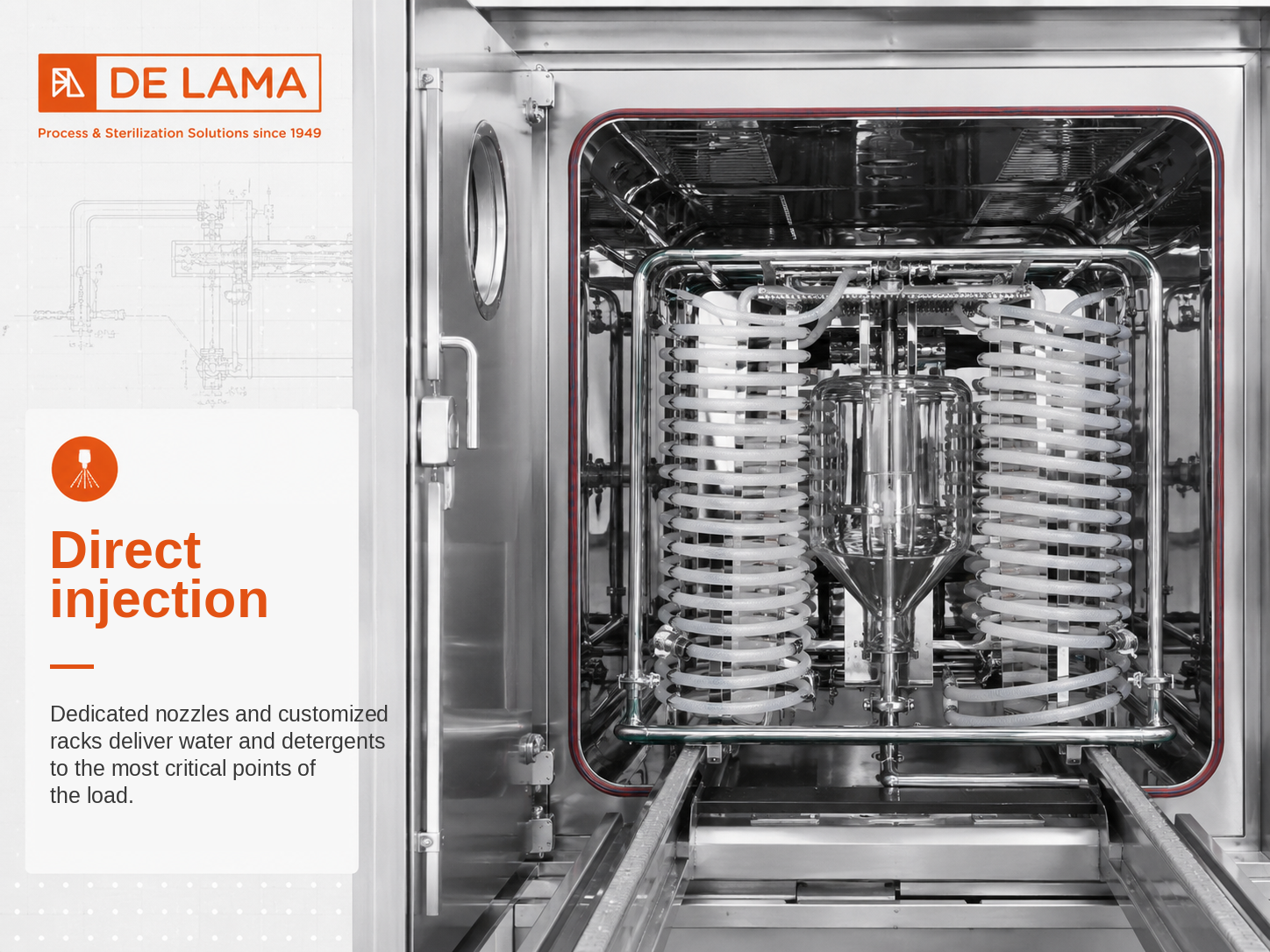
Two factors decide whether a cycle actually cleans: water quality and washing action. Intermediate rinses may use softened or purified water, while the final rinse typically uses purified water (PW) or water for injection (WFI), so that no contaminants are reintroduced at the last step. The washing action itself combines fixed nozzles and rotating spray arms, which reach external surfaces, with direct-injection systems that channel water inside items with complex internal geometries, such as containers, tubing and hollow bodies. The force and coverage of the spray, often described as impingement, determine how effectively soil is removed from difficult surfaces. On customized racks for complex loads, injection nozzles can be mounted directly on the trolley, which connects to the machine’s circuit and delivers water and detergents to precise points of the load.
Thermal disinfection and the A0 value
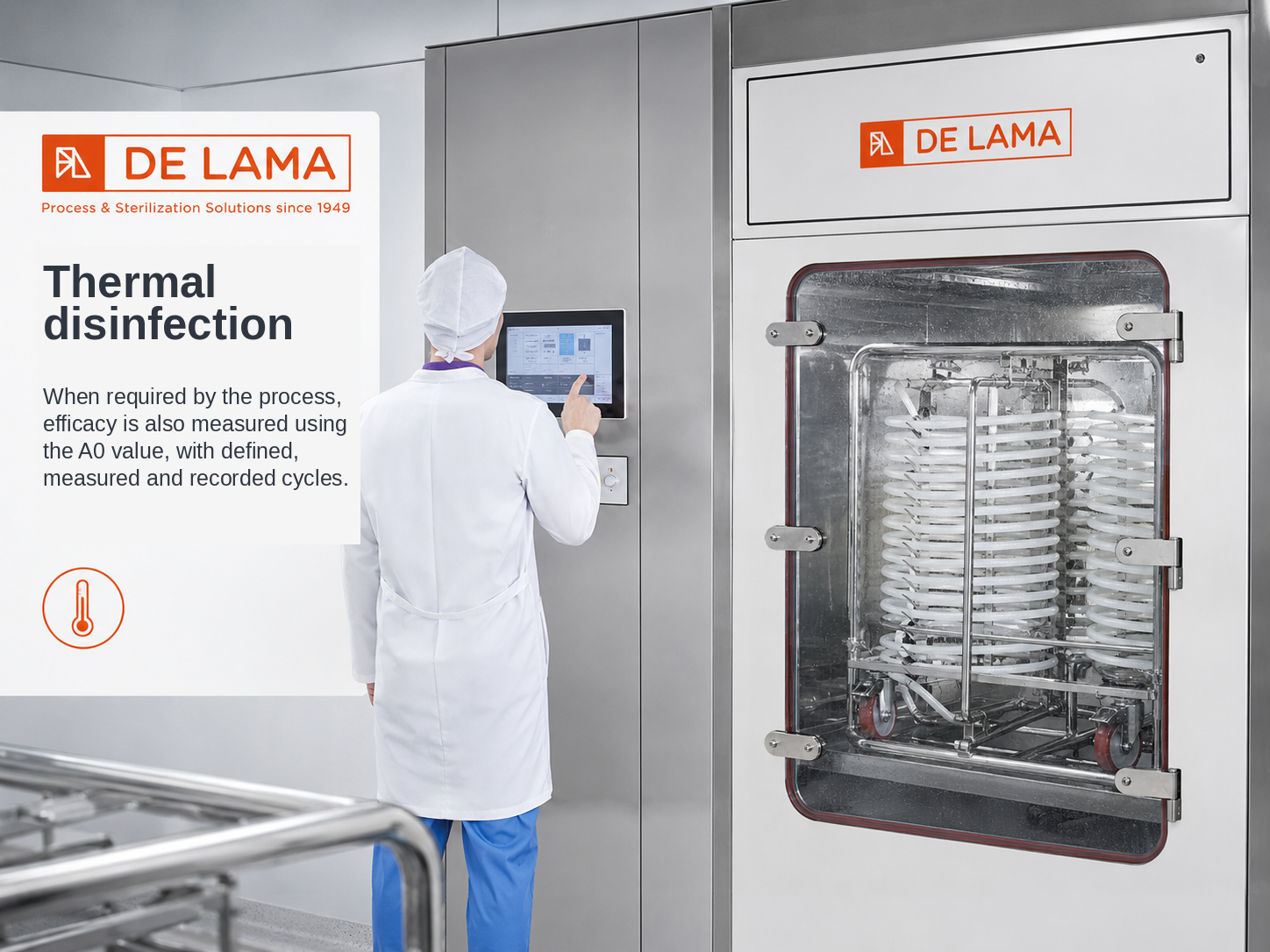
A thermal washer disinfector achieves disinfection with heat rather than chemicals, leaving no residues to remove. Its efficacy is expressed by the A0 value, defined in EN ISO 15883 for washer-disinfectors. The A0 value is the equivalent exposure time, in seconds, at 80 °C needed to deliver a given lethal effect on microorganisms, assuming a z-value of 10 °C. In practice, an A0 of 600 corresponds to 10 minutes at 80 °C, or a shorter time at higher temperatures, and is a common reference for many applications; more demanding risk profiles call for higher levels, such as A0 3000. Because the disinfection level is defined numerically, it can be verified and reproduced cycle after cycle. The advantage of the thermal approach is twofold: reproducible results and no chemical residues to rinse away, which also simplifies the downstream cleaning validation.
Washer-Disinfectors in Pharma and Medical Device Manufacturing
Across regulated industries, the washer-disinfector sits at the center of the quality chain, where cross-contamination is a concrete risk. In pharmaceutical, biotech, medical device, cosmetic and nutraceutical production, it ensures that reusable equipment returns to service clean, disinfected and fully documented, ready for the next batch or for sterilization.
Typical applications and loads
A medical washer disinfector handles a wide range of loads: stainless steel accessories, trolleys, containers, trays and drums, machine parts and change parts, filling-line components, animal cages and operating tables. Each load family calls for dedicated baskets or racks that hold the items in a defined, repeatable position. Small parts with narrow lumens, such as needles and tubular instruments, are the hardest to reach; here the patented Ultrasoniclean® solution adds ultrasonic washing to improve efficiency and cycle repeatability where conventional spray systems reach their limits.
Batch, tunnel and pass-through configurations
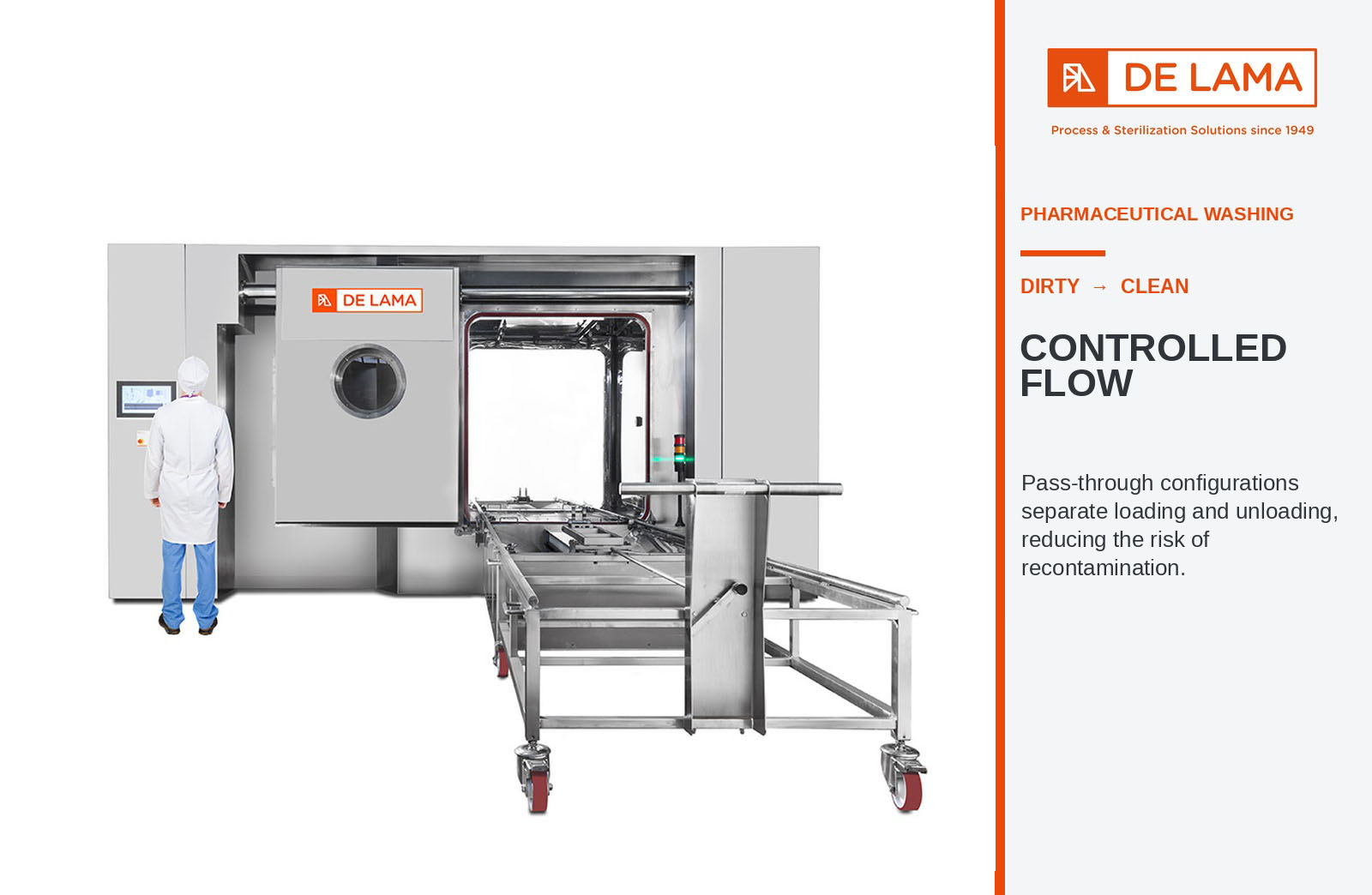
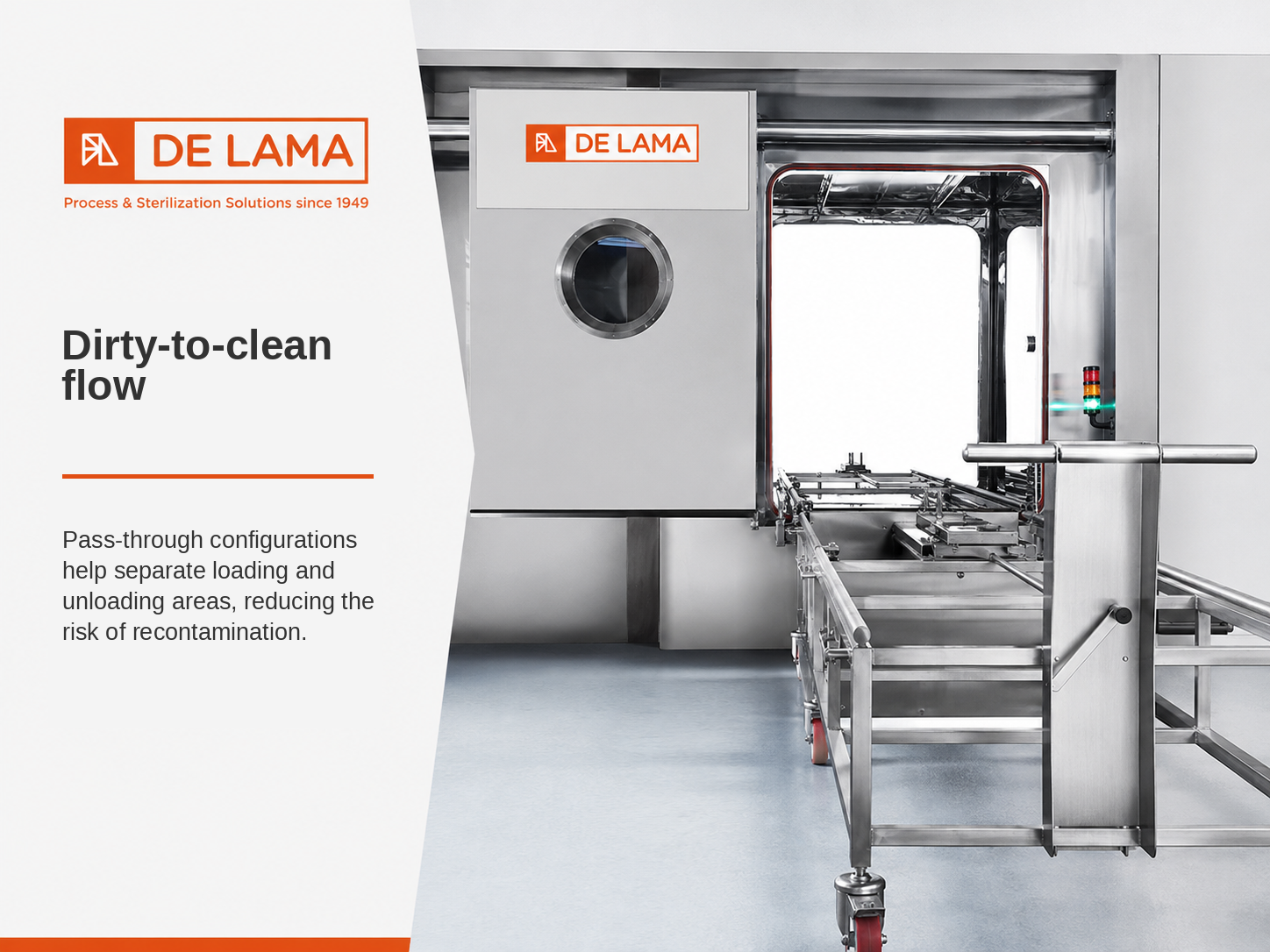
Washer-disinfectors come in different layouts to suit volume and workflow. Batch machines treat one load at a time inside a chamber and are available with a single door or with a double, pass-through door that separates the loading (dirty) side from the unloading (clean) side, reducing the risk of recontamination and supporting a clear dirty-to-clean flow. Tunnel and continuous systems move loads through successive stations and suit high-throughput production. For fixed process equipment that cannot be dismantled, such as tanks and piping, cleaning is handled instead by CIP (Cleaning In Place) and SIP (Sterilization In Place) systems, a closed-loop approach that is complementary to, but distinct from, chamber washer-disinfectors.
Standards and Validation: Why They Matter (ISO 15883)
The reference standard for washer-disinfectors is the EN ISO 15883 series, which sets general requirements, type tests and the A0 methodology for thermal disinfection, and defines routine and periodic checks to confirm ongoing performance. Compliance is reinforced by cGMP and FDA requirements and, in the EU, by Annex 15 of the EU GMP, which governs qualification and validation. Together they frame both what the machine must do and how it must be proven to do it.
Cleaning validation and residue limits
Washer disinfector validation is the documented evidence that the cleaning and disinfection process consistently keeps residues below predefined acceptance limits. The approach has shifted in recent years: the old empirical criteria, such as the 10 ppm limit or a fraction of the therapeutic dose, have given way to toxicology-based limits. Today residue limits are derived from Health-Based Exposure Limits (HBEL) and the Permitted Daily Exposure (PDE), from which the MACO (Maximum Allowable Carryover), the largest residue that may transfer to the next batch, is calculated. A robust cleaning validation protocol then defines the worst case, the sampling methods (swab and rinse), the analytical methods (such as TOC and conductivity), the recovery studies and the acceptance criteria, while the machine itself is qualified through IQ, OQ and PQ and periodically requalified. This is why De Lama washer-disinfectors are engineered to fully comply with Cleaning Validation principles, with recorded and repeatable process parameters.
Choosing and Operating a Washer-Disinfector
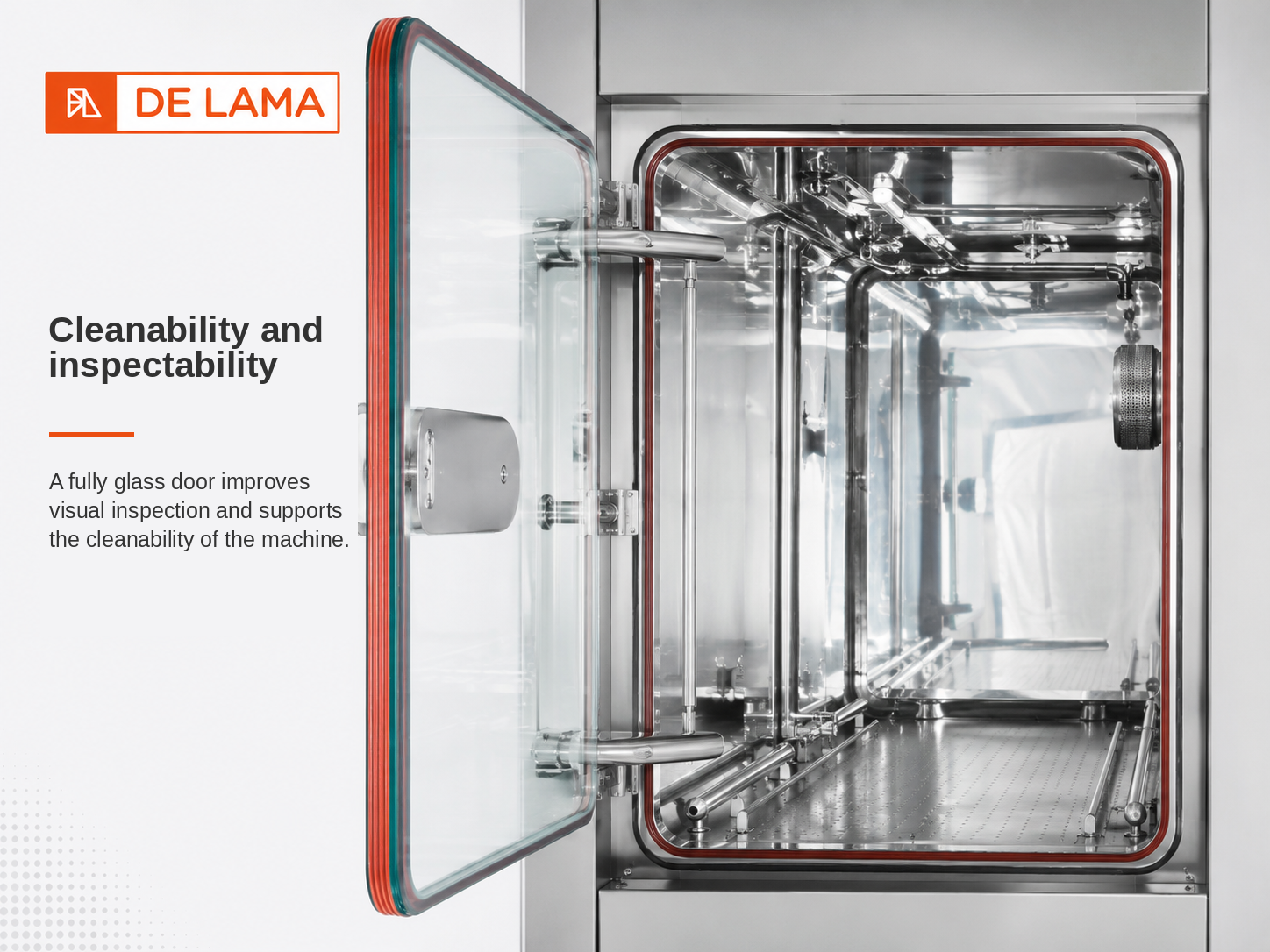
Choosing the right washer disinfector machine means matching production needs to regulatory constraints. The key criteria are load type and size (De Lama solutions span 200 to 6,000 liters), materials and cleanability (a fully glass door, with no steel frame, improves both cleanability and inspection), water quality and available utilities (compatibility with PW and WFI, steam, compressed air and power), validation readiness (IQ/OQ/PQ documentation, GAMP-compliant software and data integrity), and flexibility, with standard or fully customized configurations. Integration into the department layout, for example pass-through or barrier-mounted versions, and robust construction, which drives the machine’s service life, complete the picture.
Extreme customization: from 3D model to validated rack
For the most complex loads, De Lama takes customization further than most. It starts from a 3D model of the parts to be washed, supplied by the customer or captured with a handheld scanner, at De Lama or on the customer’s premises, where a De Lama technician can travel on site to avoid production downtime. From these models, engineers design a dedicated rack in which every part has a defined position, the condition for absolute cycle repeatability. The design is then verified with simulated spray cones that confirm three critical points: that every load surface is actually reached by the jets, that no areas are shadowed by other parts, and that the product geometry, in its assigned position, creates no water pooling in concavities. The result is a wash designed around the real load rather than adapted after the fact, and a solid basis for the subsequent cleaning validation.
Operation and maintenance
In daily use, correct operation is as important as the machine itself. Operators load the items onto the appropriate rack or basket, respecting the validated load pattern, select the validated cycle and start it; the machine then runs unattended and records the cycle data. Consistent, correct loading, with no overlapping or shadowing parts, is what allows the required A0 value to be reached and validation to hold over time. Planned preventive maintenance, together with routine monitoring and periodic requalification, keeps performance within the validated envelope and protects a service life that, for a well-built machine, is measured in decades.
With over 75 years of experience in washing, sterilization and decontamination for the most regulated industries, De Lama builds washer-disinfectors and industrial washers compliant with cGMP and FDA, in standard or customized versions. Its DLWM series, with its many configurations and variants, now covers the full pharmaceutical washing range, from laboratory glassware and parts to large containers, machine components and complex custom loads.
FAQ
What are the 5 stages of a washer disinfector?
Most washer-disinfector cycles are built around five stages: (1) flush or pre-wash to remove gross soil, (2) detergent wash, (3) rinse, (4) thermal disinfection, and (5) drying. Depending on the application, extra intermediate rinses or a final high-purity rinse (PW or WFI) may be added.
How to use a washer disinfector?
The operator loads the items onto the appropriate rack or basket, respecting the validated load pattern, selects the validated cycle for that load, and starts it. The machine then runs unattended through washing, disinfection and drying, and records the cycle data. Correct loading, with no overlapping or shadowing parts, is essential to reach the required A0 value and pass validation.
What is the difference between a washer-disinfector and an autoclave?
A washer-disinfector cleans and thermally disinfects a load, reducing the microbial burden to a safe, defined level; an autoclave (steam sterilizer) sterilizes, eliminating all viable microorganisms. In many workflows the washer-disinfector prepares the load and sterilization follows, and some De Lama units combine both washing and steam sterilization in a single machine.
How long do industrial washers last?
A well-designed industrial washer-disinfector, properly maintained, has a service life measured in decades. Durability depends mainly on material and build quality (stainless steel and components) and on regular preventive maintenance.
What can I put in my washing machine to disinfect it?
That question usually refers to domestic laundry, which is a different context. In a regulated environment, disinfection is not achieved by adding a product to an ordinary machine but through a validated thermal cycle in a washer-disinfector, where heat, measured by the A0 value, delivers reproducible, residue-free disinfection.