Ethylene Oxide Sterilization: How It Works, Limitations and Alternatives
Ethylene oxide sterilization (EtO sterilization) has been one of the most widely used methods for decades to process medical devices and components that cannot withstand the heat of saturated steam. According to figures released by the FDA in 2024, about half of the medical devices that require sterilization in the United States are processed with EtO. Yet ethylene oxide is a toxic, flammable gas classified as a carcinogen, subject to strict requirements on emissions, worker exposure and product residuals, within a regulatory framework that is still evolving.
In this article we look at how ethylene oxide sterilization works, what its real limitations are, and which low-temperature sterilization technologies, starting with vaporized hydrogen peroxide (vH₂O₂), can replace it fully or in part.
What Is Ethylene Oxide (EtO) Sterilization?
Ethylene oxide (C₂H₄O) is a colorless gas at room temperature, highly reactive and belonging to the epoxide family. Its sterilizing action is based on alkylation: the molecule reacts with the amino, carboxyl, sulfhydryl and hydroxyl groups of proteins and nucleic acids, blocking the metabolism and replication of microorganisms, including bacterial spores.
The main advantage of EtO gas sterilization is the combination of low temperature (typically between 37 and 63 °C) and high penetration: the gas passes through porous packaging, permeable plastic films and complex geometries such as long, narrow lumens. This is why ethylene oxide has become the reference method for catheters, infusion sets, surgical kits, polymer devices and products already sealed in their final packaging.
To reduce flammability risks (the gas forms explosive mixtures with air over a very wide range), many facilities use EtO and CO₂ mixtures, with typical concentrations of 10% ethylene oxide and 90% carbon dioxide, or pure EtO in chambers designed to operate under vacuum in a nitrogen-inerted atmosphere.
How the EtO Sterilization Cycle Works
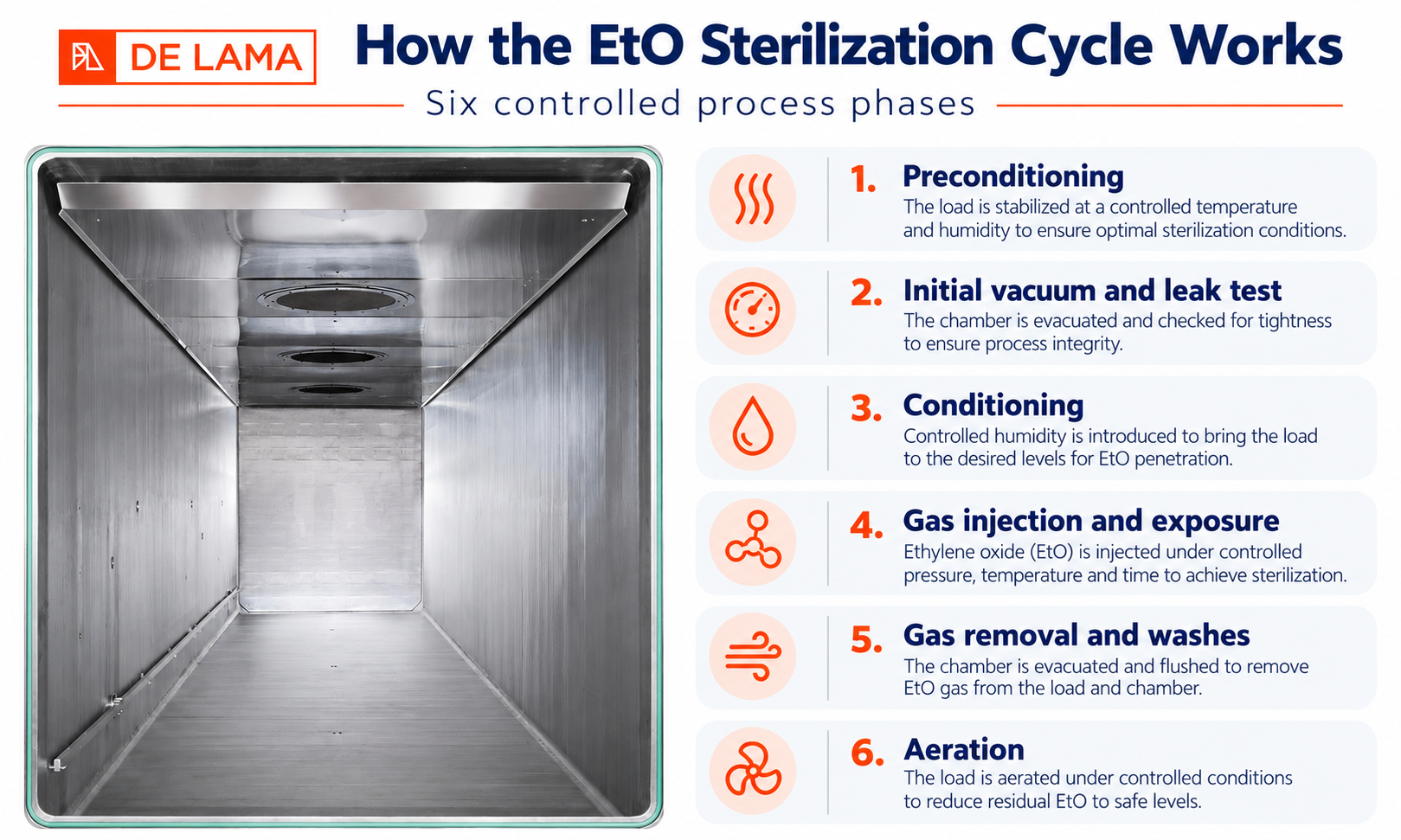
How does ethylene oxide sterilization work in practice?The EtO sterilization process is governed by ISO 11135, the international ethylene oxide sterilization standard for health care products, and is divided into well-defined phases:
1. Preconditioning. The load is brought to controlled temperature and humidity, often in a dedicated room, for several hours or up to a full day.
2. Initial vacuum and leak test. The chamber is evacuated to remove air and allow the gas to penetrate the load.
3. Conditioning. Steam is injected to reach a relative humidity typically between 40% and 80%. Controlled humidity supports the microbiological effectiveness of the process.
4. Gas injection and exposure. EtO is introduced up to the target concentration (indicative values between 450 and 1,200 mg/L, to be defined during validation) and held for the validated exposure time, usually one to six hours.
5. Gas removal and washes. The gas is removed through a series of vacuum pulses alternated with injections of filtered air or nitrogen, and sent to an abatement system (catalytic or scrubber).
6. Aeration. The load remains in the chamber or in heated aeration rooms until EtO residuals and by-products fall below the permitted limits.
The main process parameters to control and record include gas concentration, temperature, relative humidity, pressure and exposure time. Routine monitoring relies on biological indicators with Bacillus atrophaeus spores and on a chemical ethylene oxide indicator (ISO 11140-1), which changes color when exposed to the gas: the color change confirms exposure to the process, not product sterility. For medical devices, parametric release is possible only when the process is validated against specific requirements (ISO 11135 and ISO/TS 21387), while in pharmaceutical manufacturing EU GMP Annex 1 requires biological indicators for every cycle. As with any terminal sterilization process, the target is a Sterility Assurance Level (SAL) of 10⁻⁶.
Ethylene oxide sterilization validation follows the classic sequence of installation qualification (IQ), operational qualification (OQ) and performance qualification (PQ). Microbiological PQ is commonly carried out with the half-cycle approach, which demonstrates inactivation of the biological indicators with half the routine exposure time. Physical PQ confirms that temperature, humidity and gas distribution are uniform throughout the load.
Industrial ethylene oxide sterilization equipment, such as De Lama’s DLOG series, integrates the chamber, gas dosing, humidity control and emission abatement into a single cGMP-compliant architecture.
The Limitations of Ethylene Oxide
The versatility of EtO comes at a price. Its limitations concern the safety of people, regulatory compliance and plant productivity, and they explain why many manufacturers are working to reduce their dependence on it.
Toxicity, residual limits and regulatory constraints (ISO 11135, EU GMP Annex 1)
The same ability to alkylate DNA that makes ethylene oxide effective against microorganisms makes it genotoxic to humans. IARC classifies it in Group 1 (carcinogenic to humans), and the European CLP Regulation classifies it as a category 1B carcinogen and mutagen. The occupational exposure limit is 1 ppm as an 8-hour time-weighted average both in the European Union (1.8 mg/m³) and under the US OSHA standard.
On the product side, EtO and ethylene chlorohydrin (ECH) residuals must comply with ISO 10993-7. Its third edition (April 2026) updates the derivation of allowable limits and extraction conditions according to patient population and duration of use, and allows risk assessment to set device-specific limits.
In pharmaceutical manufacturing, EU GMP Annex 1 favors terminal sterilization by heat and states that ethylene oxide sterilization should be used only when no other method is practicable, requiring evidence that the process has no damaging effect on the product and that residuals are adequately removed.
Why is ethylene oxide being phased out? In most applications it is not banned, but it is under increasing pressure. Emissions from commercial sterilizers are subject to strict control requirements, and in the United States the EPA emission standards adopted in 2024 are currently being reconsidered, which adds regulatory uncertainty. Together with community concerns near sterilization sites and the FDA’s programs encouraging alternative methods, this is pushing many manufacturers to diversify their sterilization strategy.
Cycle times, aeration and throughput impact
Adding up preconditioning, exposure and aeration, an ethylene oxide cycle can take, depending on the load and the facility, from less than a day to several days before the batch can be released. On top of this come the handling of gas cylinders or tanks, abatement systems, environmental monitoring and residual testing. For many companies the result is a logistical bottleneck and, often, dependence on external contract sterilizers.
Low-Temperature Alternatives to EtO
What are the alternatives to EtO sterilization? No technology is a universal replacement, but two families cover most applications of low temperature sterilization: vaporized hydrogen peroxide and ionizing radiation.
Vaporized hydrogen peroxide (vH₂O₂)
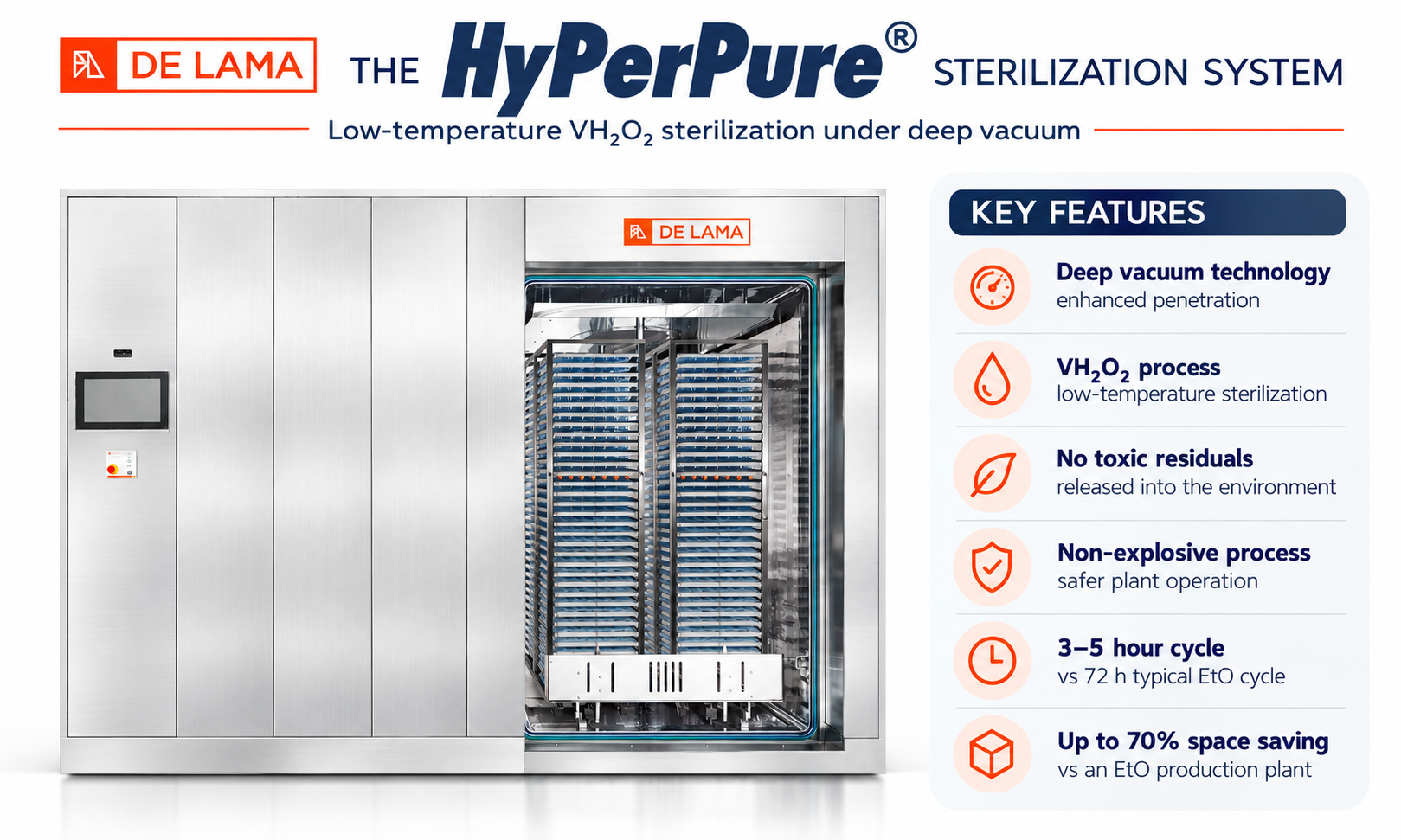
Vaporized hydrogen peroxide sterilization operates at temperatures indicatively between 25 and 55 °C. vH₂O₂ acts by oxidizing proteins, lipids and nucleic acids and, at the end of the cycle, breaks down into water and oxygen. It leaves no EtO or ECH residuals, and sterilant removal takes place within the cycle, without external aeration rooms; the absence of residual peroxide on the product is still verified during validation. Cycles are measured in hours, not days.
On January 8, 2024, the FDA recognized vH₂O₂ as an Established Category A sterilization method, on the same level as steam, dry heat, EtO and radiation. This was a key step for medical device manufacturers aiming to reduce their reliance on ethylene oxide.
The historical limitation of hydrogen peroxide is penetration into dense loads, lumens and multiple packaging layers. This is where high vacuum makes the difference: De Lama’s patented HyPerPure® high-vacuum technology can sterilize through at least 4 layers of Tyvek®, making it possible to process products sealed in their final packaging. With HyPerPure®, cellulose and porous materials are not a limitation: cleanroom garments, medical-grade paper and fabrics are routinely sterilized. The only material to avoid is double-wall corrugated cardboard, which traps peroxide and acts as a barrier during the injection phase: the sterilant would take too long to penetrate the product and too long to be removed during degassing, making the process inefficient. Liquids, on the other hand, cannot be sterilized with vH₂O₂, because peroxide does not penetrate them.
Gamma and e-beam irradiation
Gamma sterilization (cobalt-60 sources) and electron beam (e-beam) sterilization, governed by ISO 11137, take place at room temperature and leave no chemical residuals. Gamma rays have high penetration and can treat entire pallets; e-beam is much faster but penetrates less and suits low-density products.
The limitations relate to materials and logistics: some polymers, such as PTFE and certain PVC and polypropylene formulations, can degrade, discolor or become brittle depending on the dose, and irradiation almost always requires shipping products to external facilities, with the associated transport times. X-ray sterilization is an emerging option with penetration comparable to gamma.
How to Choose the Right Alternative: Material Compatibility, Scale, Validation
The choice between ethylene oxide and alternative technologies must be made product by product, considering three dimensions.
▸ Material and packaging compatibility. With high-vacuum vH₂O₂ (HyPerPure®), double-wall corrugated cardboard must be avoided, while cellulose and porous materials are compatible; radiation-sensitive polymers may rule out gamma and e-beam. Packaging must be checked and, if necessary, modified: in gas or vapor processes it must be permeable to the sterilant, like Tyvek®.
▸ Scale and production organization. Radiation is efficient for large volumes processed by contract sterilizers; vH₂O₂ enables in-house sterilization, in the department or in line, reducing inventory and lead times.
▸ Validation. Moving from EtO to a new method is a significant change: it requires new process validation, material compatibility testing, biological evaluation, verification of packaging integrity and device performance, as well as the regulatory steps required by the target market.
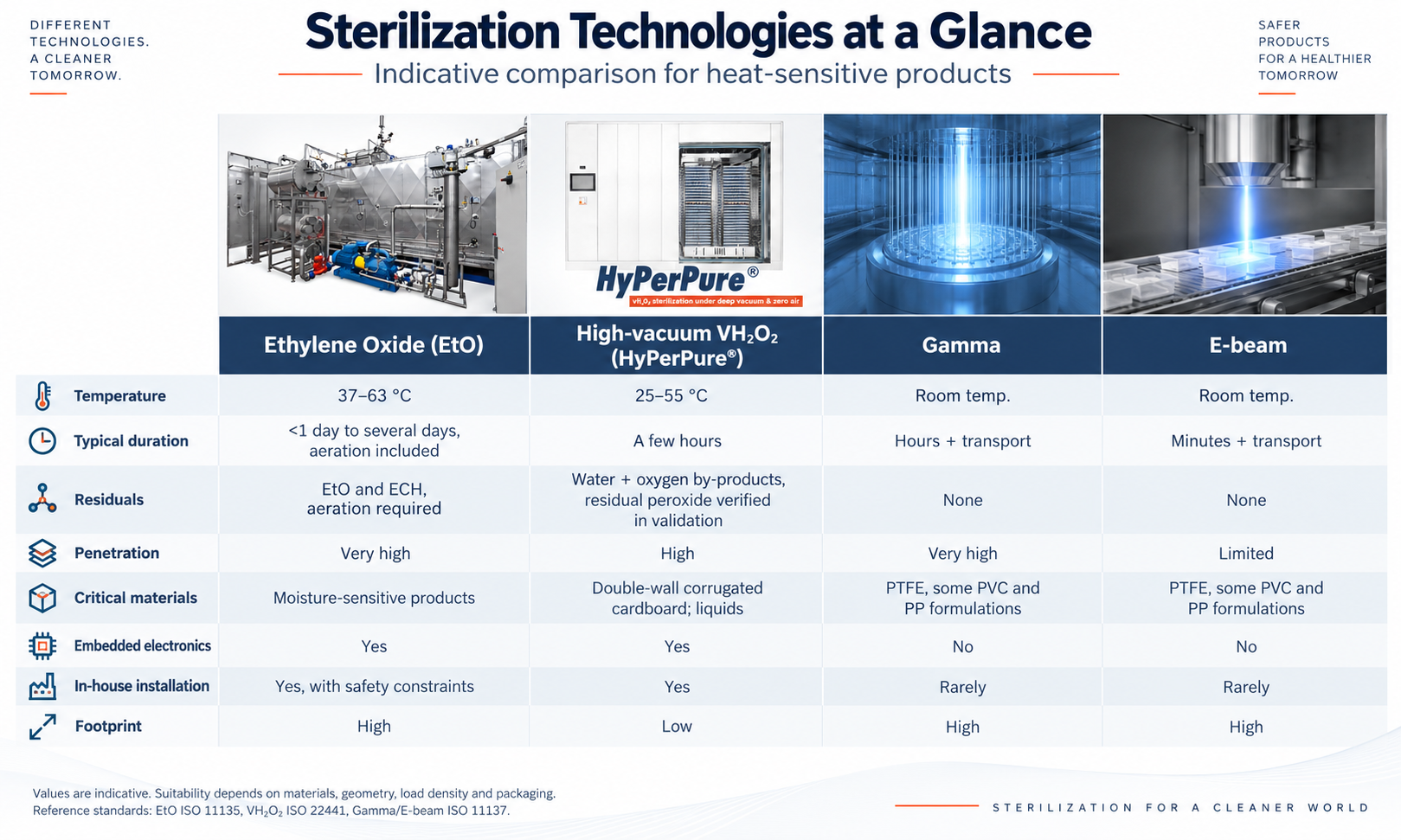
The table summarizes the main differences. Values are indicative: times, penetration and compatibility depend on materials, geometry, load density and packaging.
Ethylene oxide
High-vacuum vH₂O₂ (HyPerPure®)
Gamma
E-beam
Temperature
37-63 °C
25-55 °C
Room temperature (slight product heating)
Room temperature (slight product heating)
Typical duration
Less than 1 to several days, aeration included
A few hours
Hours (plus transport)
Minutes (plus transport)
Residuals
EtO and ECH, aeration required
Breaks down into water and oxygen; residual peroxide verified in validation
None
None
Preconditioning
Yes (temperature and humidity, up to 24 hours)
No
No
No
Post-conditioning
Yes (aeration, hours to days)
No (sterilant removal integrated in the cycle)
No
No
Penetration
Very high
High
Very high
Limited
Critical materials
Moisture-sensitive products
Double-wall corrugated cardboard; liquids
PTFE, some PVC and PP formulations
PTFE, some PVC and PP formulations
Devices with embedded electronics (e.g. pacemakers)
Yes
Yes
No
No
Reference standard
ISO 11135
ISO 22441
ISO 11137
ISO 11137
In-house installation
Yes, with safety constraints
Yes
Rarely
Rarely
Footprint
High (preconditioning and aeration rooms, gas storage, abatement)
Low
High (shielded bunker)
High (accelerator and shielding)
With over 75 years of experience in pharmaceutical sterilization, De Lama offers a range of low temperature and high precision autoclaves designed for heat-sensitive loads. A complete overview of available methods is provided in our guide to the sterilization process.
FAQ
Is ethylene oxide sterilization safe?
For patients, EtO-sterilized products are safe when the process is validated and residuals comply with ISO 10993-7. The gas itself, however, is hazardous: it is classified as a Group 1 carcinogen by IARC and is also mutagenic and irritating to the eyes, skin and respiratory tract. This is why facilities must ensure sealed chambers, emission abatement, environmental monitoring and adequate aeration of the product.
What products are sterilized with ethylene oxide?
Mainly heat-sensitive, packaged medical devices: catheters, infusion and dialysis sets, single-use surgical kits, sutures, and devices with electronic or polymer components. In the pharmaceutical sector its use is more limited and mainly concerns components, containers and primary packaging.
Do you need some more information? Let us assist you and answer all your questions.