Terminal Sterilization vs Aseptic Processing: How to Choose
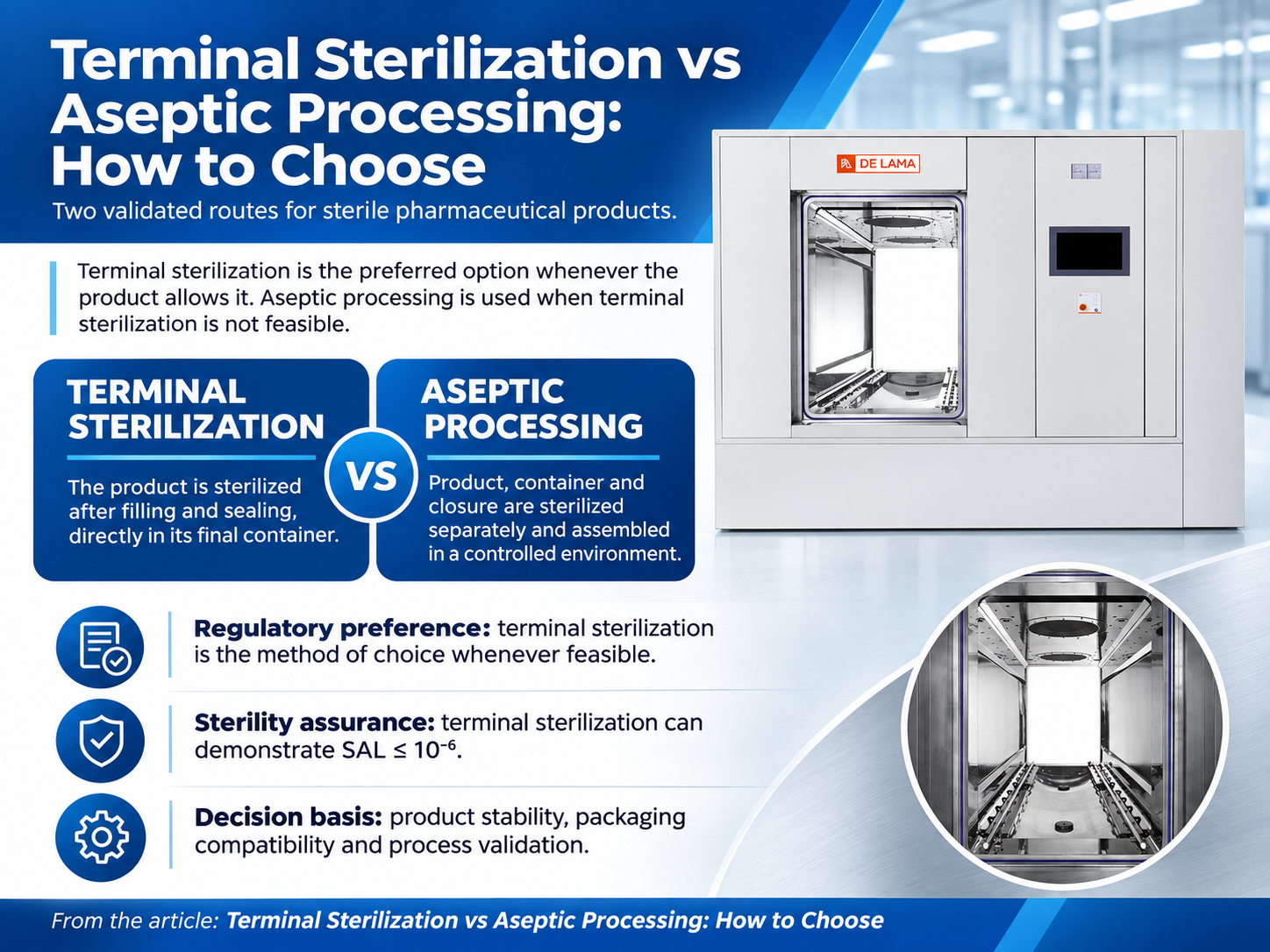
Every sterile medicinal product reaches a fundamental decision point during development: sterilize the product after it has been filled and sealed in its final container, or manufacture it aseptically, bringing together product and components that have already been sterilized in a controlled environment. The first route is terminal sterilization, the second is aseptic processing. The difference goes well beyond technique: it changes the level of sterility assurance that can be demonstrated, how the process is validated, the layout of the facility and the size of the investment.
Regulators have a clear preference. The European Pharmacopoeia, the EMA sterilisation guideline, EU GMP Annex 1 and the FDA all point to terminal sterilization as the first choice whenever the product allows it. Many medicines, especially heat-sensitive formulations, still require aseptic processing. This article explains what separates the two approaches, why the 10⁻⁶ sterility assurance level of terminal sterilization cannot be compared with the 10⁻³ figure quoted in some historical media fill references, and which criteria to use when choosing.
What Is Terminal Sterilization?
Terminal sterilization definition: terminal sterilization is the process in which the product is sterilized after filling and sealing, directly in its final container (ampoule, vial, bag, prefilled syringe) or, for medical devices, inside its sterile barrier system. After the cycle the product is no longer exposed to aseptic manipulation: maintaining sterility depends on the integrity of the container closure system, or of the sterile barrier, during storage, handling and transport.
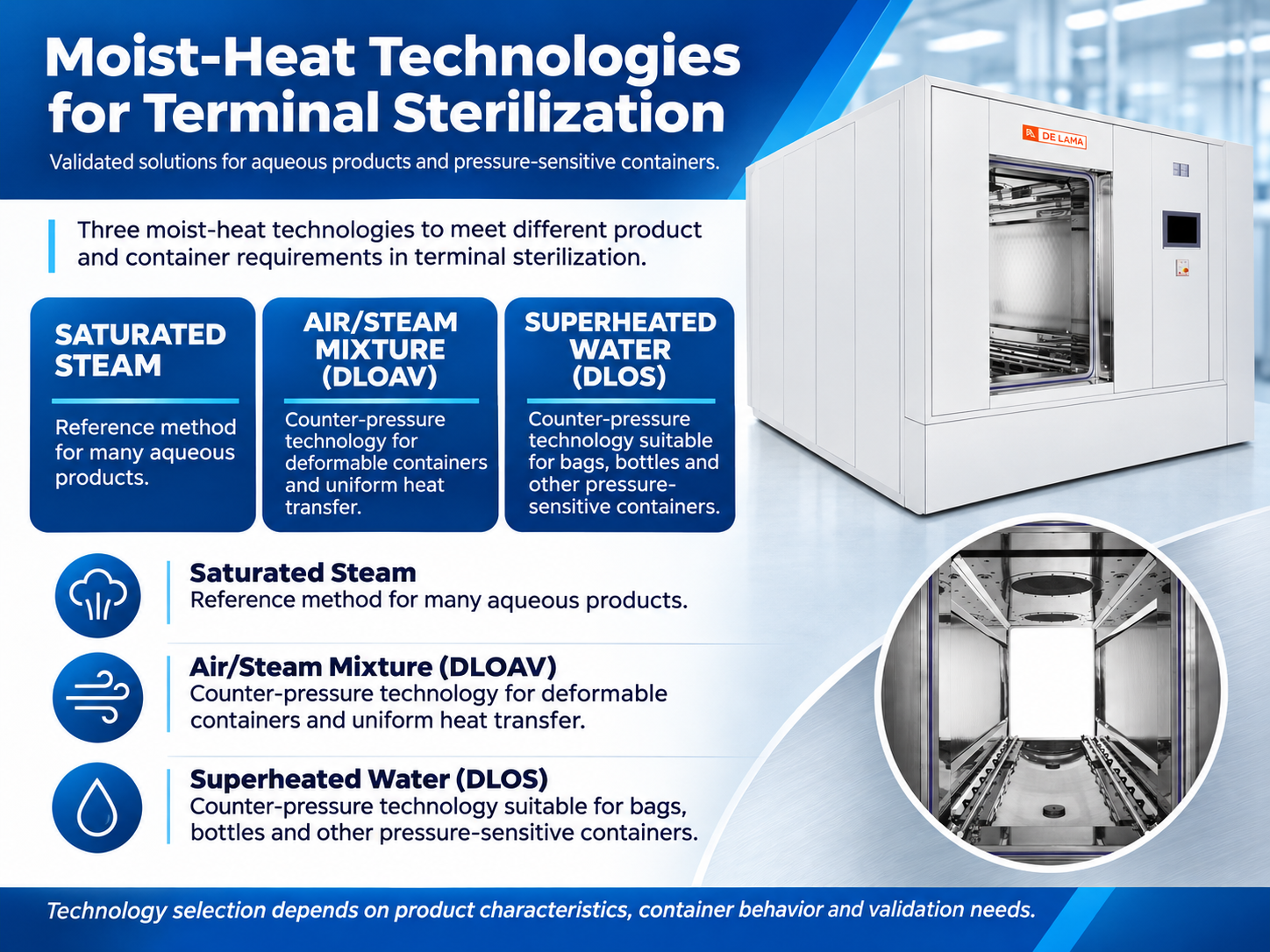
For aqueous products the reference method is moist heat sterilization with steam. The European Pharmacopoeia sets the standard condition at a minimum of 121 °C for at least 15 minutes. The EMA guideline also accepts alternative cycles, provided they deliver a lethality of F₀ ≥ 8 minutes, a holding temperature of at least 110 °C and a demonstrated SAL ≤ 10⁻⁶; a product temperature below 115 °C during the holding phase is considered an exceptional case, to be justified with additional data. Calculating and verifying F₀, a parameter specific to moist heat processes, is a core part of autoclave validation.
When the container is deformable or builds up high internal pressure, as with some PP or PE bags and bottles, conventional saturated steam may give way to counter-pressure processes: air/steam mixture and superheated water sterilization, which balance the internal pressure of the containers during heating and cooling and preserve their integrity.
Products and devices that cannot withstand heat can rely on other terminal sterilization methods: ionizing radiation (gamma and e-beam, with a reference dose of 25 kGy, or other doses if justified and validated) and ethylene oxide. For compatible, suitably packaged medical devices, vaporized hydrogen peroxide (vH₂O₂) is also available: the FDA recognized it as an Established Category A method on January 8, 2024. This recognizes the method; it does not replace validation of each individual system and cycle. For a complete overview of the available methods, see our article on the sterilization process. The EMA and GMP criteria discussed below apply to medicinal products; medical devices follow their own standards and requirements.
What Is Aseptic Processing?
In aseptic processing, product, container and closure are sterilized separately, each with the most suitable method, and then brought together in an environment designed to prevent contamination. When the formulation can be filtered, the solution is sterilized by filtration through a sterilizing-grade membrane, typically 0.22 µm. Glass vials are usually depyrogenated and sterilized with dry heat, stoppers and machine parts are processed in saturated steam autoclaves, while heat-sensitive components require low-temperature sterilization technologies compatible with their materials.
In pharmaceutical aseptic processing, filling and closing take place in Grade A. Under EU GMP Annex 1, the background is Grade B for conventional cleanrooms and for RABS; for isolators it is generally at least Grade C for open isolators and at least Grade D for closed ones, based on risk assessment and the site Contamination Control Strategy (CCS). RABS and isolators reduce human intervention and protect the critical zone, but they do not replace Grade A where the product is exposed.
The sterility assurance of the finished product therefore depends on many factors at once: the effectiveness of every component sterilization step, filter integrity, equipment design and qualification, air quality, operator behavior and the transfer of materials into the critical zone. Every manual intervention and every transfer is a potential contamination point. Aseptic processes are validated through design, process controls, training and environmental monitoring, verified by aseptic process simulations (APS or media fills): Annex 1 states that the media fill should not be considered the primary means of validating the aseptic process.
Despite these constraints, aseptic processing remains essential for many product classes: biologics, monoclonal antibodies, vaccines, emulsions and complex formulations that heat would irreversibly degrade.
Sterility Assurance Level: Why 10⁻⁶ Is Not 10⁻³
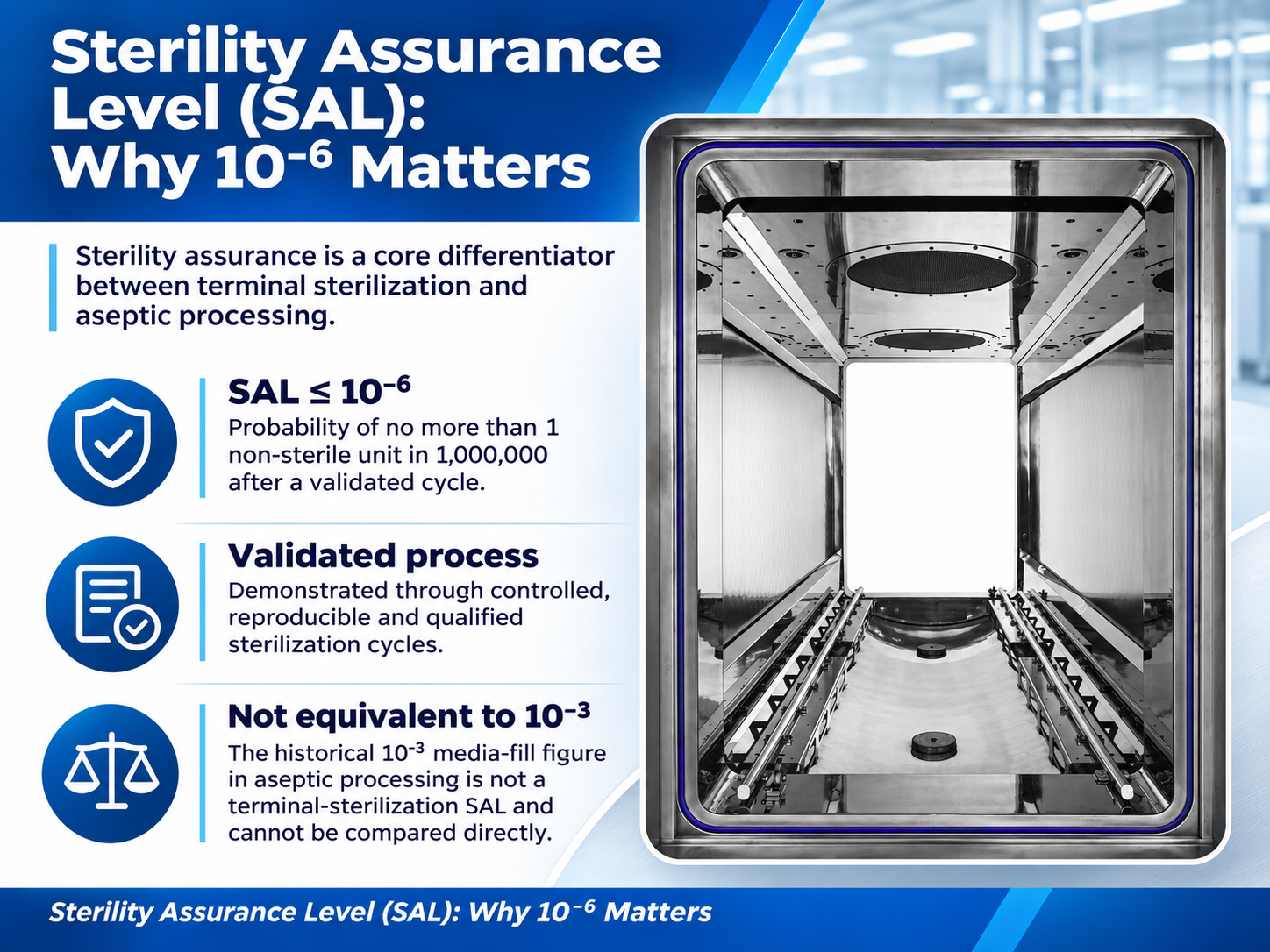
The Sterility Assurance Level (SAL) is the theoretical probability that a single unit remains non-sterile after a validated sterilization process. An SAL of 10⁻⁶ means an estimated probability of no more than one in a million: it does not mean that one contaminated unit per million is allowed or expected. It is the reference for terminally sterilized medicinal products and, under the applicable standards, for medical devices labeled as sterile.
The SAL can be estimated because microbial inactivation in a sterilization process follows known kinetics: from the initial bioburden, the resistance of the microorganisms (D value) and the lethality of the cycle, it is possible to demonstrate how many log reductions the process delivers. Validation evidence, such as physical parameters and biological indicators, depends on the technology: F₀, for example, applies to moist heat and not to radiation or gas processes.
This logic does not apply to aseptic processing. Contamination, when it occurs, is not governed by inactivation kinetics but by random events: an operator intervention, a loss of integrity, an error during a transfer. The 10⁻³ figure often quoted comes from historical media fill acceptance criteria, which tolerated a contamination rate of up to 0.1%. It is not an SAL for the commercial product and cannot be numerically compared with the 10⁻⁶ of a terminal process: the two values measure different things.
The 2022 revision of Annex 1 tightened the criteria: the target for aseptic process simulations is zero growth, and any contaminated unit results in a failed simulation and an investigation. This still does not amount to demonstrating an SAL of 10⁻⁶: a media fill verifies, under simulated conditions and together with the other elements of the control system, the ability of the process to prevent contamination, but it does not measure the probability of contamination of each commercial batch.
Parameter (medicinal products)
Terminal sterilization
Aseptic processing
Sterility assurance
SAL ≤ 10⁻⁶ demonstrated for the validated cycle
No equivalent SAL; asepsis assured by validated processes, APS and monitoring
When sterilization occurs
Product already sealed in its final container
Product, container and closure separately, before assembly
Recontamination risk
No handling after the cycle; sterility maintained if the container closure stays intact
Present during exposure and transfers; controlled through barriers and CCS
How it is demonstrated
Cycle validation, physical parameters, biological indicators; F₀ for moist heat
Process qualification and controls, monitoring, APS, personnel training
Filling environment
At least Grade C, unless specific contamination risks apply
Grade A; Grade B background (conventional and RABS), open isolators at least C, closed at least D
Typical methods
Saturated steam, air/steam mixture, superheated water, radiation, gas
Sterilizing filtration plus separate sterilization of components and equipment
Regulatory position
Method of choice
Acceptable when terminal sterilization is not feasible, with justification
What Regulators Expect
European and US regulators agree on one point for medicinal products: terminal sterilization is the method of choice, and aseptic processing must be justified.
‣ European Pharmacopoeia (chapter 5.1.1): wherever possible, a process in which the product is sterilized in its final container is chosen.
‣ EMA Guideline on the sterilisation of the medicinal product, active substance, excipient and primary container (EMA/CHMP/CVMP/QWP/850374/2015, effective October 1, 2019): it defines terminal sterilization as the method of choice and provides separate decision trees for aqueous products, non-aqueous products and containers.
‣ EU GMP Annex 1 (EudraLex Volume 4, revision published on August 25, 2022 and applicable from August 25, 2023): finished products should be terminally sterilized where possible; where this is not possible, post-aseptic processing terminal heat treatment should be considered. Every choice must fit within the site Contamination Control Strategy.
‣ FDA aseptic processing guidance: the Guidance for Industry “Sterile Drug Products Produced by Aseptic Processing: Current Good Manufacturing Practice” (2004) treats aseptic processing as the route to follow when terminal sterilization is not feasible. It calls for an ISO 5 critical area, an adjacent supporting area of at least ISO 7, and media fills with three consecutive successful runs for initial qualification followed by semi-annual requalification of each line. The legal basis is 21 CFR 211.113(b), which requires validation of all aseptic and sterilization processes.
In summary, the EMA decision tree for aqueous products follows this sequence:
1. steam sterilization at a minimum of 121 °C for at least 15 minutes, the Pharmacopoeia reference condition;
2. if the product cannot tolerate it, an alternative steam cycle with F₀ ≥ 8 minutes and a demonstrated SAL ≤ 10⁻⁶;
3. if that is not feasible either, filtration through a microbial retentive filter and aseptic filling into pre-sterilized containers;
4. if the product cannot be filtered, aseptic processing from pre-sterilized components, with appropriate justification.
Once aseptic processing is selected, both the guideline and Annex 1 ask manufacturers to consider post-aseptic processing terminal heat treatment, a moist heat cycle with F₀ below 8 minutes that increases sterility assurance. Ionizing radiation, on the other hand, appears in the decision tree for non-aqueous and semi-solid products, not in the one for aqueous products.
Two points in the guideline carry real weight in practice. Heat sensitivity of the container cannot on its own justify abandoning terminal sterilization: alternative materials must be investigated and the efforts made must be documented. Conversely, aseptic processing may be accepted even for a product that could be terminally sterilized when it brings a tangible benefit to the patient or user, such as single-drop eye drop containers or plastic vials for cytotoxic medicines, which are safer to handle.
How to Choose in Practice
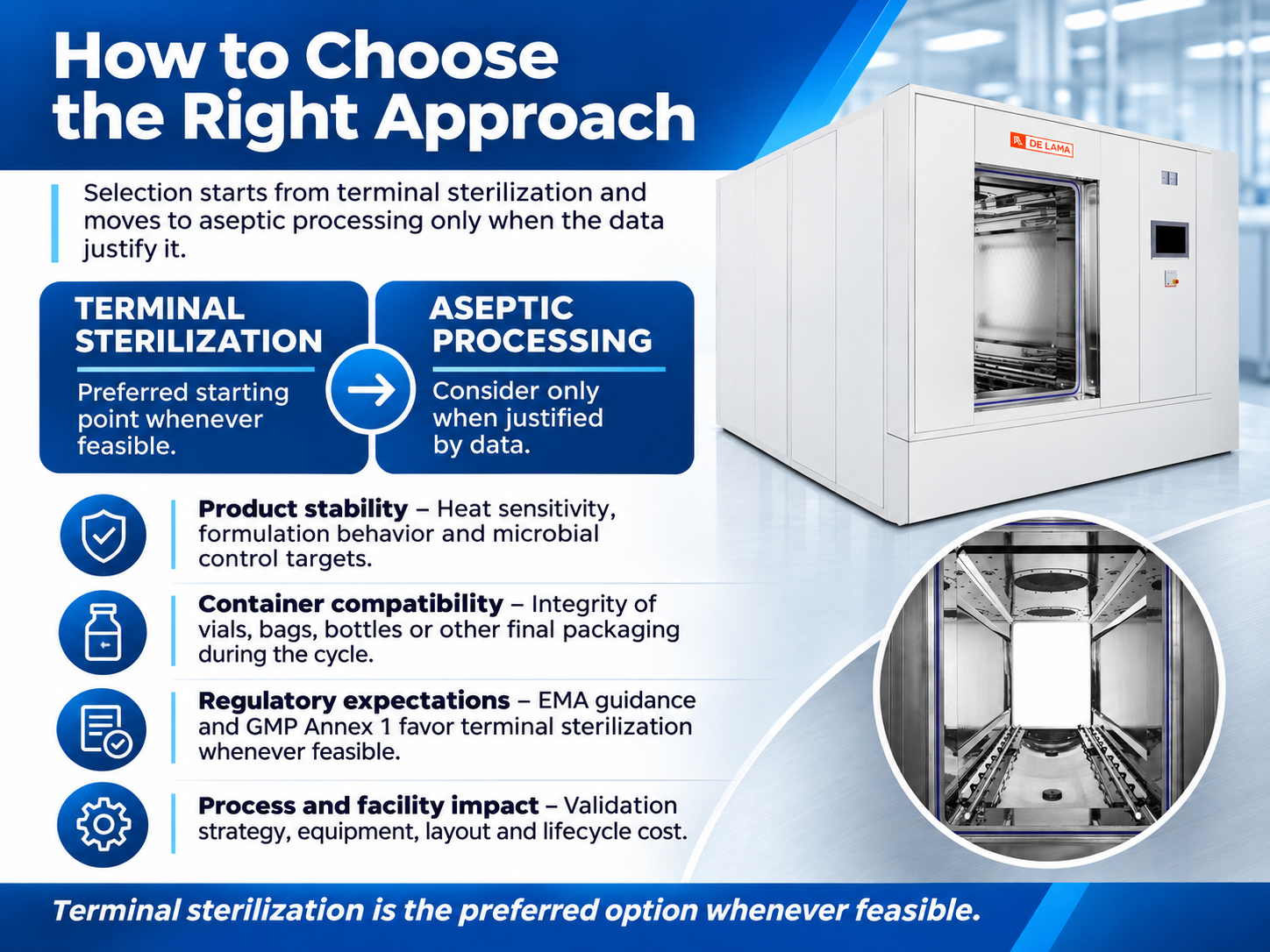
The choice starts from terminal sterilization and moves down the decision tree only when the data make it unfeasible. Product stability, container closure compatibility and the ability to validate the process are decisive; layout, production capacity and lifecycle costs complete the picture, but they do not replace the scientific and regulatory justification.
Product stability and container compatibility
Terminal sterilization should not be ruled out simply because the product cannot withstand the 121 °C, 15-minute reference cycle. An alternative cycle designed around the actual bioburden can significantly reduce thermal stress, as long as it meets F₀ ≥ 8 minutes, a holding temperature of at least 110 °C and the required SAL; below 115 °C product temperature, additional data are needed. Before switching to aseptic processing, it is worth studying degradation at different F₀ values and assessing formulation options such as pH, buffer system and stabilizing excipients.
The container can be the limiting factor. Rigid glass generally tolerates steam cycles well, while some plastic containers, bags and certain prefilled syringes may require counter-pressure processes to prevent deformation, breakage or plunger movement. Container closure integrity must be verified after the cycle in line with the product control strategy.
For many medical devices made of polymers or containing heat-sensitive components, low-temperature terminal sterilization is the way forward, where compatible with materials and packaging. Here, vH₂O₂ with HyPerPure® high vacuum technology is an alternative to ethylene oxide: it penetrates at least 4 layers of Tyvek®, as documented by De Lama and presented at international conferences, and requires no separate preconditioning or aeration phases, because sterilant removal is integrated into the cycle and validated against the release criteria. As with any technology, each load requires a validated cycle. vH₂O₂ does not, however, sterilize liquid formulations: for heat-labile solutions that can be filtered, the route is sterilizing filtration followed by aseptic processing.
Impact on equipment, facility layout and capital investment
With terminal sterilization of medicinal products, filling normally takes place in at least Grade C, and sterility relies on a validated step applied to the packaged product: steam, air/steam mixture or superheated water autoclave sterilization downstream of the line. The facility needs sterilizers sized to the batch, often pass-through between two areas, and utilities suited to the chosen technology. Media fills are not required, but bioburden control, cycle validation and container closure integrity remain essential.
Aseptic processing shifts the burden onto the environment and people: Grade A with a background suited to the chosen solution, more demanding HVAC systems, gowning and personnel qualification, environmental monitoring and process simulations normally repeated twice a year for each process, line and shift. The aseptic processing equipment list is also longer, because every component entering the critical zone must be sterilized and transferred without losing its sterile status: saturated steam autoclaves, depyrogenation ovens and tunnels and, for heat-sensitive materials, true validated low-temperature sterilization, to be kept distinct from simple H₂O₂ biodecontamination. Direct integration between sterilizer and isolator reduces manual transfers and the risks they bring.
The choice made during development also shapes later decisions. Changing the sterilization process of an authorized medicinal product may require a variation to the dossier and new validation work. Assessing terminal sterilization thoroughly from the outset, where technically feasible, can avoid costly redesign.
FAQ
When is aseptic processing allowed instead of terminal sterilization?
When terminal sterilization is not feasible for documented product stability reasons, after the alternatives in the EMA decision tree have been examined, or when aseptic processing offers a documented benefit to the patient or user. The choice must be justified in the marketing authorization dossier; container incompatibility, without evaluating alternative solutions, is not normally sufficient justification.
What sterility assurance level is required for terminal sterilization?
For terminally sterilized medicinal products the reference is an SAL ≤ 10⁻⁶, meaning a theoretical probability of no more than one in a million that a single unit remains non-sterile after the validated cycle. A comparable level applies to medical devices labeled as sterile under EN 556-1. It is not the number of contaminated units that may be found in a batch.
Why is terminal sterilization preferred?
Because the product is sterilized in its sealed container, with a lethality that can be measured and an SAL that can be demonstrated. Aseptic processing depends on preventing contamination throughout an entire chain of operations, and its assurance cannot be expressed in the same quantitative terms.
What is the difference between terminal sterilization and aseptic processing?
In terminal sterilization the product is sterilized already sealed in its final container, and sterility is maintained as long as the closure remains intact. In aseptic processing, product and components are sterilized separately and then combined in a controlled environment: sterility assurance depends on control of the entire production chain and is not expressed as an SAL calculated in the same way as for a terminal cycle.
De Lama Expertise
For over 75 years De Lama has designed and built equipment for both routes. For terminal sterilization of parenteral and infusion solutions, in rigid and deformable containers, it offers saturated steam sterilizers, DLOAV air/steam mixture sterilizers and DLOS superheated water sterilizers. For aseptic processing it supplies autoclaves and depyrogenation ovens for components and equipment, isolator integration solutions such as Magnetodoor®, and HyPerPure® sterilizers using vH₂O₂ under high vacuum for materials that cannot withstand heat.