Autoclave Validation (IQ/OQ/PQ): Requirements, Process and Best Practices
In pharmaceutical and medical device manufacturing, it is not enough for an autoclave to complete its cycle without alarms. Manufacturers are required to demonstrate, through documented and reproducible evidence, that the process consistently delivers the intended sterilization conditions across the defined load configurations. This is the purpose of autoclave validation: a structured path that starts from user requirements and continues throughout the operating life of the equipment, ensuring that the validated state is maintained over time.
This guide covers what autoclave validation means, which regulatory requirements and guidelines apply, how the IQ, OQ, CD and PQ stages are organised, which tests and acceptance criteria are typically considered, and which best practices make sterilization validation genuinely effective.
What Is Autoclave Validation?
Validation is the collection and evaluation of documented evidence demonstrating that a process consistently produces results meeting predetermined specifications and acceptance criteria.
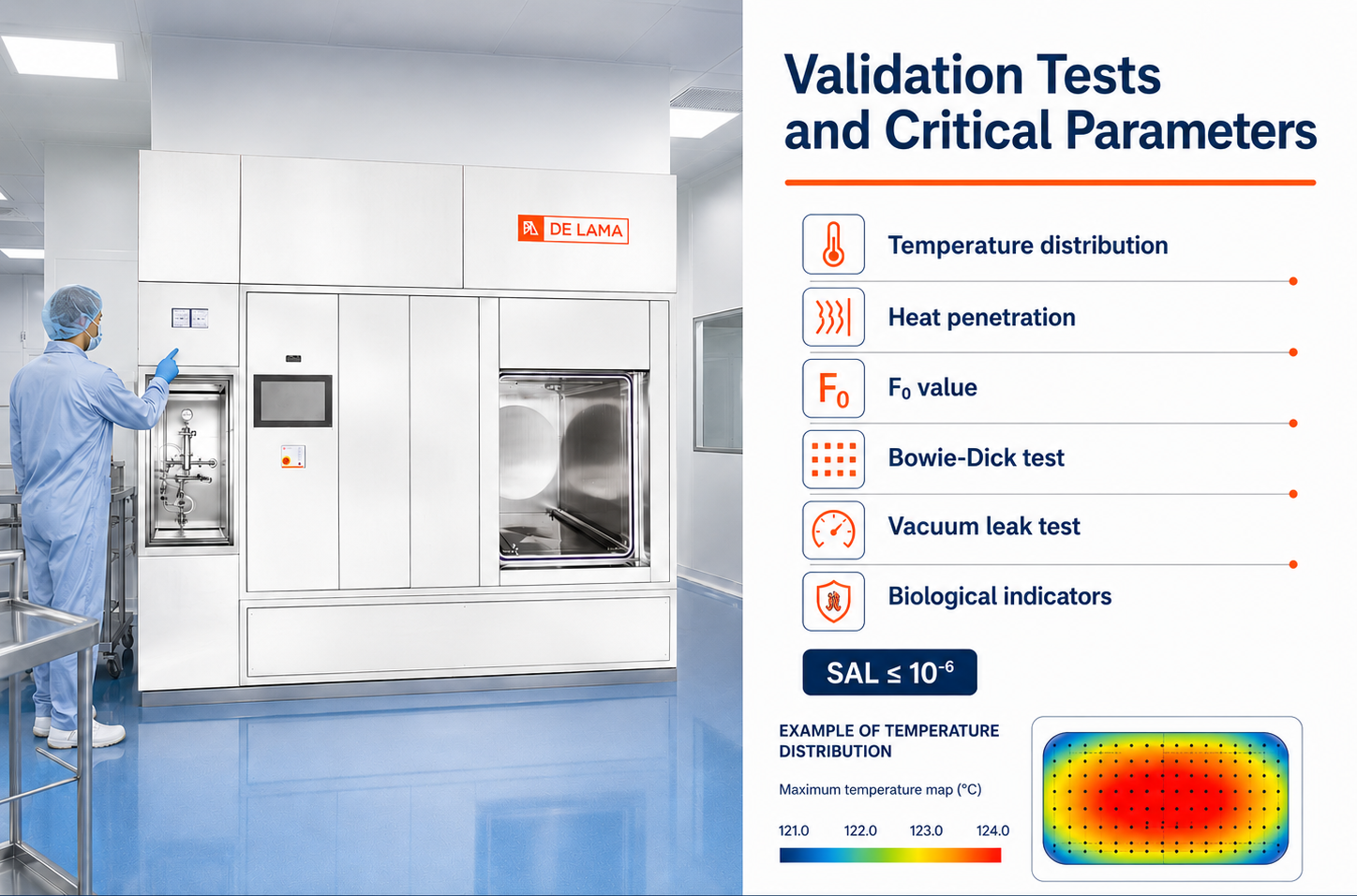
Applied to steam sterilization, sterilizer validation demonstrates that a defined cycle, run on a defined load under defined conditions, achieves the level of microbiological safety required by the process. Where applicable, the reference objective of a sterilization process is expressed as a Sterility Assurance Level (SAL) ≤ 10⁻⁶, corresponding to a probability of no more than one in a million that a single unit remains non-sterile.
It is important to distinguish between equipment qualification and process validation.
Qualification verifies that the autoclave has been correctly installed and operates as specified. Validation addresses the process as a whole: equipment, sterilization cycle, load configuration and the characteristics of the materials being processed. For this reason, significant changes to the load, to process parameters or to the installation must be assessed to determine their potential impact on the validated state.
In saturated steam sterilization, process effectiveness depends on the ability of steam to reach not only the surfaces, but also to penetrate correctly into every part of the load, including the coldest point or the point most difficult to reach, transferring energy through condensation at every location. Residual air or inadequate steam penetration can compromise the process even when the parameters recorded by the autoclave appear to be correct. Validation is precisely what verifies that the intended conditions are actually achieved, including in the least favourable positions of the load.
Regulatory Requirements and Guidelines (GMP, EN 285, EN ISO 17665, USP)
Autoclave validation requirements derive from an articulated regulatory framework that varies according to sector, product and intended use.
In the European pharmaceutical context, two key references are EudraLex Volume 4Annex 15 and Annex 1.
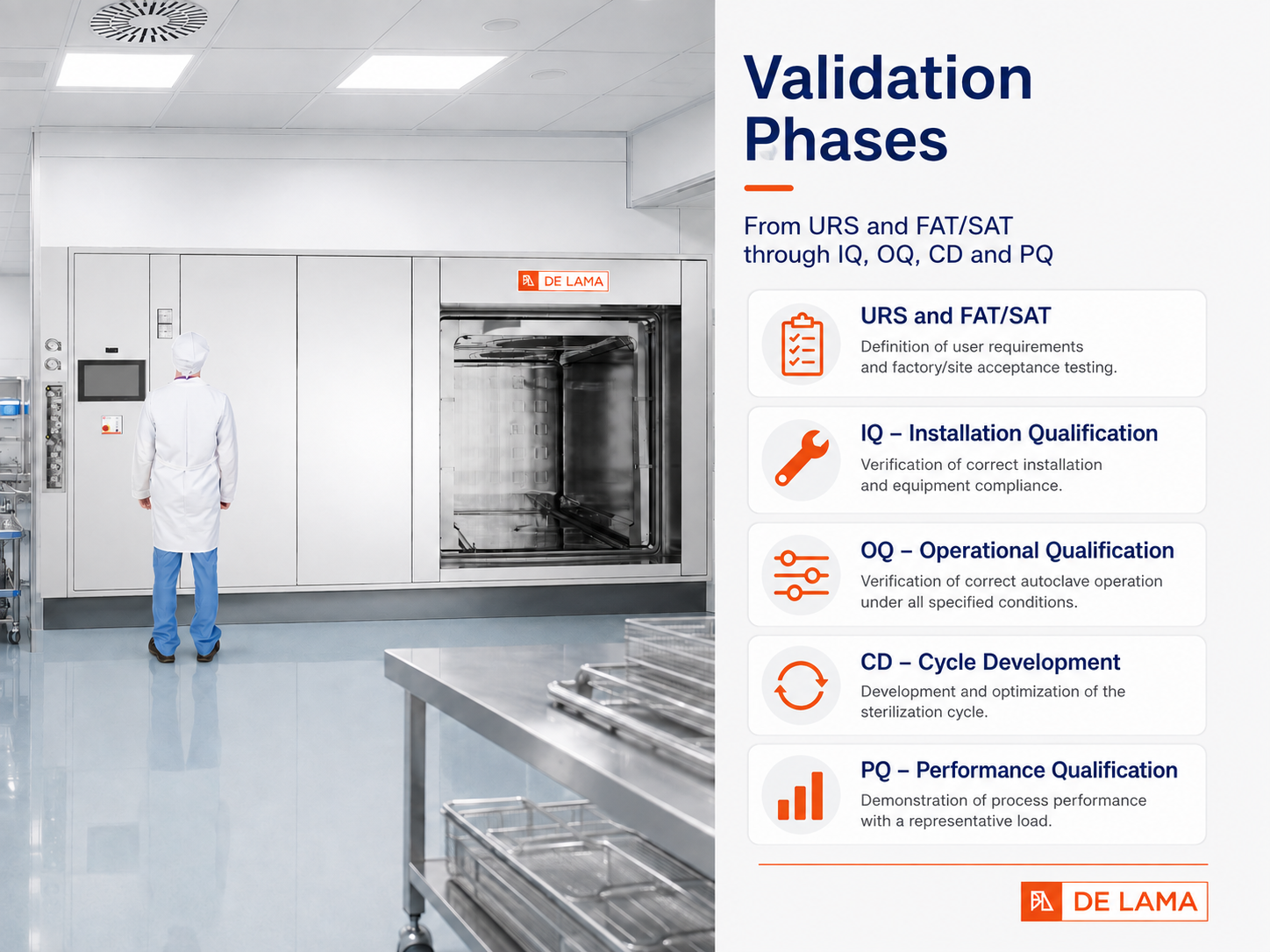
Annex 15, Qualification and Validation, defines the lifecycle approach to qualification and validation, from User Requirements Specifications (URS) and design qualification through IQ, OQ, CD and PQ, change management and requalification.
Annex 1, dedicated to the manufacture of sterile medicinal products, requires sterilization processes to be adequately validated and integrated into the wider Contamination Control Strategy (CCS), addressing aspects such as load configuration, bioburden control and maintenance of the validated state.
For large steam sterilizers, EN 285 is a key technical reference, defining requirements and tests covering, among other aspects, chamber leak tightness, air removal, temperature distribution and steam quality.
EN ISO 17665 is one of the main international references for the development, validation and routine control of moist heat sterilization processes, and is widely applied to IQ/OQ/PQ for medical devices.
In the United States, 21 CFR 211.113 and the FDA process validation guidance set out equivalent expectations, while the United States Pharmacopeia provides informational general chapters on steam sterilization by direct contact and on the use of biological indicators, frequently referenced in autoclave validation guidelines for the US market.
Depending on the application, further standards and references may apply, covering biological and chemical indicators, microbiological control, computerised systems, data integrity and pressure equipment. The framework must therefore be interpreted in relation to the specific application, without treating any single standard as universally applicable to every autoclave or process.
The Validation Stages: IQ, OQ, CD and PQ
IQ/OQ/PQ validation is the operational core of qualification and validation, but it belongs to a wider path that begins with the definition of the URS and the design of the installation.
A well structured FAT allows many functions of the autoclave to be verified in advance, reducing activities and potential deviations during subsequent on-site qualification.
Installation Qualification (IQ)
Installation Qualification verifies and documents that the autoclave is installed in accordance with design specifications, URS and approved documentation.
Typical checks include:
▸ identification of the equipment and of its main components;
▸ verification of materials and technical documentation;
▸ correct installation and connection of utilities;
▸ verification of critical instrumentation and its calibration status;
▸ availability of manuals and operating procedures;
▸ verification of hardware and software configuration;
▸ control of the documentation required by the project.
Any discrepancy must be documented, assessed and managed according to quality system procedures.
Operational Qualification (OQ)
Operational Qualification demonstrates that the autoclave operates correctly across the intended operating range. During this stage, the functioning of the individual cycle phases, alarms, interlocks, safety devices and the main functions of the control system are verified.
Tests normally included in OQ, where applicable, are:
▸ vacuum leak test;
▸ air removal verification;
▸ temperature distribution in the chamber;
▸ verification of the main process conditions;
▸ steam quality control;
▸ verification of data recording and management.
Particular attention is also given to computerised systems, access management, recording of process parameters and audit trail, in line with applicable data integrity requirements.
Cycle Development (CD)
Cycle Development is the stage in which the parameters of the sterilization cycle are defined, developed and optimised, taking into account the characteristics of the autoclave, the product and the intended load configurations.
The objective is to identify a cycle capable of ensuring effective air removal, correct steam penetration and adequate heat transfer, achieving the required sterilization conditions even in the parts of the load that are hardest to reach, including the core of the load and the most critical points.
Depending on the cycle type and the load, Cycle Development may address:
▸ the parameters of the individual cycle phases, such as pre-vacuum, heating, sterilization, drying or cooling;
▸ the effectiveness of air removal and steam penetration;
▸ temperature distribution inside the chamber;
▸ heat penetration into the load, using sensors placed in the positions considered most critical;
▸ heating-up and temperature stabilisation times;
▸ the behaviour of the load during the sterilization and drying or cooling phases;
▸ achievement and maintenance of the intended process parameters;
▸ identification of worst case conditions, considering load configurations, quantities, materials and product characteristics.
Cycle Development may involve several trial cycles, progressively adjusting process parameters and load configuration in order to identify a combination of conditions that ensures robustness, repeatability and process effectiveness. The results obtained during Cycle Development provide the technical basis for defining the cycle to be subsequently submitted to Performance Qualification. The selected cycle and its parameters must be documented and justified on the basis of the experimental data collected during development.
Performance Qualification (PQ)
Performance Qualification demonstrates that the process reproducibly achieves the required performance on the defined load configurations.
The PQ protocol establishes the number of cycles to be run, the configurations to be tested, sensor positioning, the parameters to be monitored and the related acceptance criteria. Tests are normally performed on loads representative of actual operating conditions, including the configurations considered most critical, or worst case.
During PQ, heat distribution and heat penetration into the load are evaluated, identifying the positions that are potentially most difficult to sterilize. Where appropriate, physical measurements may be supported by microbiological verification using biological indicators, placed in the positions identified as most critical.
The strategy must be defined and documented for the specific process, without automatically treating a single number of cycles or a given test configuration as universally valid for every application.
Key Validation Tests and Acceptance Criteria
Steam sterilization validation normally combines physical measurements of the process with microbiological verification where appropriate.
The objective is to demonstrate not only that the autoclave reaches given temperature and pressure values, but that the required treatment is effectively delivered to the load under the intended conditions.
Acceptance criteria are defined in the validation protocol and justified for the specific process. They typically address parameters such as the temperature achieved and maintained during the sterilization phase, the spread between measuring points, the target F₀ value, chamber leak tightness, steam quality and, where used, the outcome of biological indicators.
Thermal distribution, heat penetration and F₀ value
Thermal mapping analyses temperature distribution within the chamber and inside the load, using thermocouples or data loggers that are suitably calibrated and positioned according to a defined protocol.
Empty chamber tests characterise the thermal behaviour of the autoclave, while penetration tests verify that even the most critical points of the load reach the required conditions. One of the parameters used in evaluating steam sterilization cycles is the F₀ value, which expresses the thermal lethality accumulated during the process relative to a reference temperature, conventionally 121 °C. The F₀ target must be defined and justified in relation to the product, the load and the sterilization strategy adopted. An overkill approach may be used for heat-stable materials, while strategies based on the knowledge and control of bioburden may be adopted for more sensitive products.
In all cases, cycle parameters must derive from the assessment of the specific process and from its acceptance criteria.
Biological indicators and Bowie-Dick test
A biological indicator for autoclave validation contains microorganisms with known resistance characteristics. For steam sterilization, spores of Geobacillus stearothermophilus are normally used, where provided for by the validation strategy, positioned in the locations identified as most critical or within a process challenge device.
Chemical indicators, classified according to the applicable standards, confirm exposure to given process conditions but do not in themselves constitute proof of product sterility.
For the autoclaves and processes to which it applies, the Bowie-Dick test verifies the efficiency of air removal and the ability of steam to penetrate the test pack, while the vacuum leak test verifies the tightness of the chamber and of the associated system. The frequency and execution of these tests depend on the equipment, the process and the applicable regulatory requirements.
Process physics, microbiology and documentation must be considered together within the overall validation strategy.
Revalidation and Maintaining the Validated State
Validation is not an isolated activity performed at installation.
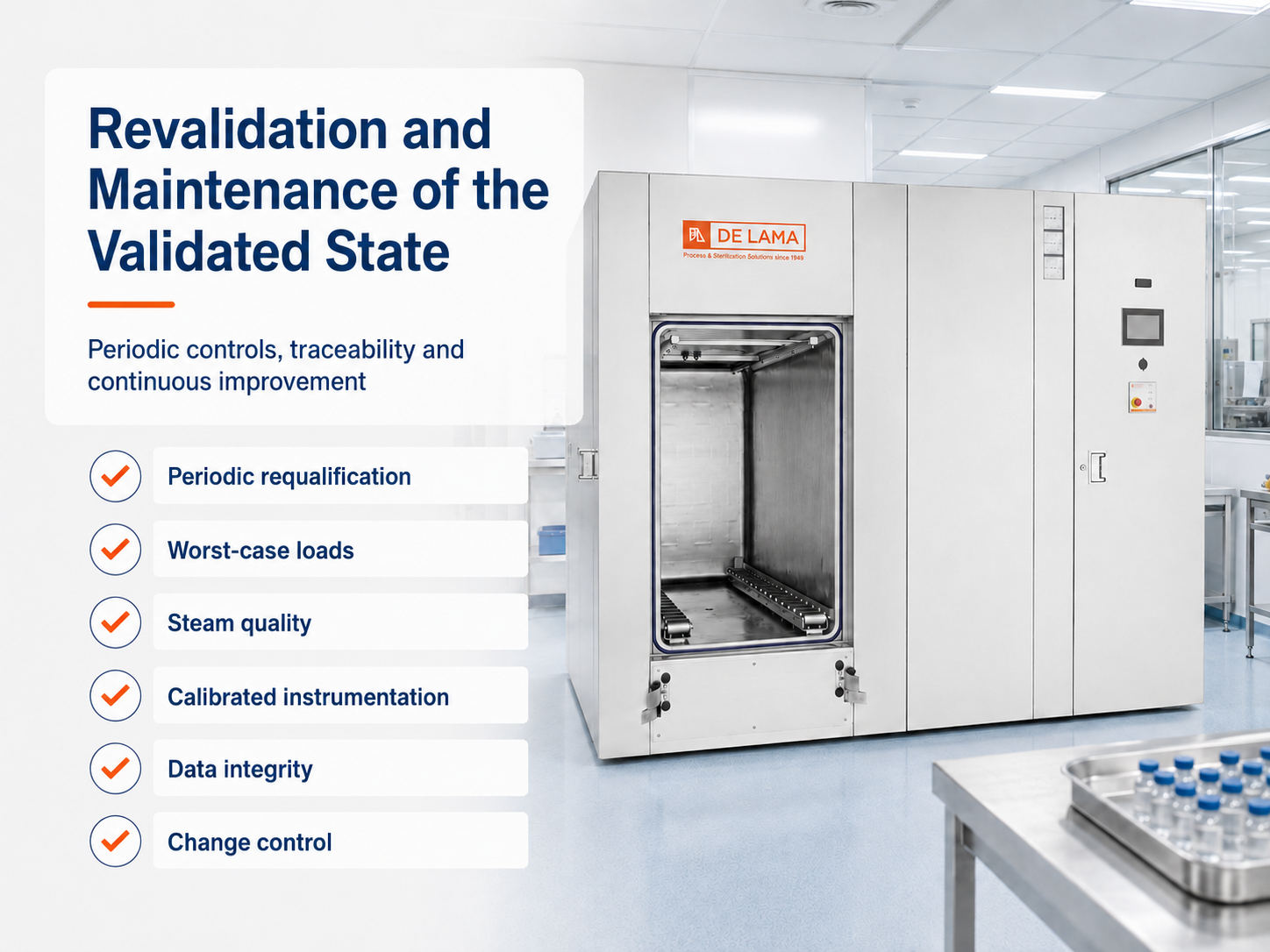
The validated state must be maintained over time through routine controls, maintenance, calibration of critical instrumentation, analysis of process data and periodic requalification.
Requalification frequency must be defined on the basis of applicable requirements and a risk assessment. In a GMP environment, particular attention is given to the periodic verification of the load configurations considered worst case.
A new assessment may also be required after significant changes, such as:
▸ interventions on the chamber or on critical components;
▸ modifications to the control software;
▸ changes to utilities or steam quality;
▸ relocation of the equipment;
▸ introduction of new loads or configurations;
▸ major repairs or technical interventions.
Such changes must be managed through the change control system, assessing their impact on the validated state in advance. Periodic review of process data also makes it possible to identify trends or performance drift before they translate into deviations. For autoclaves that have been in service for many years, structured revamping projects, followed by the necessary requalification activities, can bring the installation back in line with current requirements.
Autoclave Validation Best Practices
An effective validation begins in the earliest phases of the project.
1. Start from clear URS Defining requirements and acceptance criteria before the design phase reduces later modifications and rework.
2. Adopt a risk-based approach Quality Risk Management principles focus attention on the elements that are genuinely critical to product quality and process effectiveness.
3. Make full use of FAT and SAT Verifying as many functions as possible at the manufacturer’s premises allows criticalities to be identified early.
4. Validate realistic loads Load patterns must represent actual operating conditions, including the least favourable situations that can reasonably be expected.
5. Consider steam quality Steam quality is a determining factor for the effectiveness and repeatability of sterilization.
6. Use properly calibrated instrumentation Data quality depends directly on the reliability of the instruments used during testing.
7. Ensure data integrity and traceability Parameter recording, access management, audit trail and data protection are integral parts of the validation system.
8. Involve the autoclave manufacturer Knowledge of the equipment, of its design and of system behaviour during the cycle significantly supports the planning and execution of qualification activities.
FAQ
How often should an autoclave be validated?
There is no single interval applicable to every installation. Requalification frequency is defined on the basis of applicable requirements and a documented risk assessment, with particular attention to worst case load configurations. Between requalification campaigns, the validated state is maintained through routine testing, calibration and maintenance, while a new assessment is triggered by significant changes to the equipment, the process or the load.
What bacteria is used in autoclave validation?
Spores of Geobacillus stearothermophilus are normally used for moist heat processes, as they show high resistance to steam sterilization conditions. They are supplied as biological indicators with a known population and resistance characteristics, and are used when the validation strategy provides for microbiological verification alongside physical measurements.
What is the USP validation of an autoclave?
It refers to the approach described in the informational general chapters of the United States Pharmacopeia dealing with steam sterilization by direct contact and with biological indicators. These chapters describe cycle development, qualification and routine control practices commonly followed in the US market, and are applied alongside FDA requirements rather than as a separate validation route.
What are the acceptance criteria for autoclave validation?
There is no universal list. Acceptance criteria are defined and justified in the validation protocol for the specific equipment, process and load, and are typically expressed in terms of the temperature achieved and maintained during the sterilization phase, the spread between measuring points, the F₀ target, chamber leak tightness, steam quality and, where biological indicators are used, their outcome.
The De Lama Experience
For over 75 years, De Lama has been designing and manufacturing autoclaves and sterilization systems for the pharmaceutical and medical device industries and for research applications.
Equipment design and manufacturing are supported by qualification and validation services, with IQ, OQ, CD and PQ protocols, dedicated instrumentation and expertise developed directly on the behaviour of sterilization equipment and processes.
Involving the manufacturer from the FAT and SAT stages onwards makes it possible to integrate design, testing and qualification into a coherent path, reducing criticalities during start-up.
Contact De Lamato discuss steam sterilization solutions and to define the qualification and validation path best suited to your application.
Do you need some more information? Let us assist you and answer all your questions.