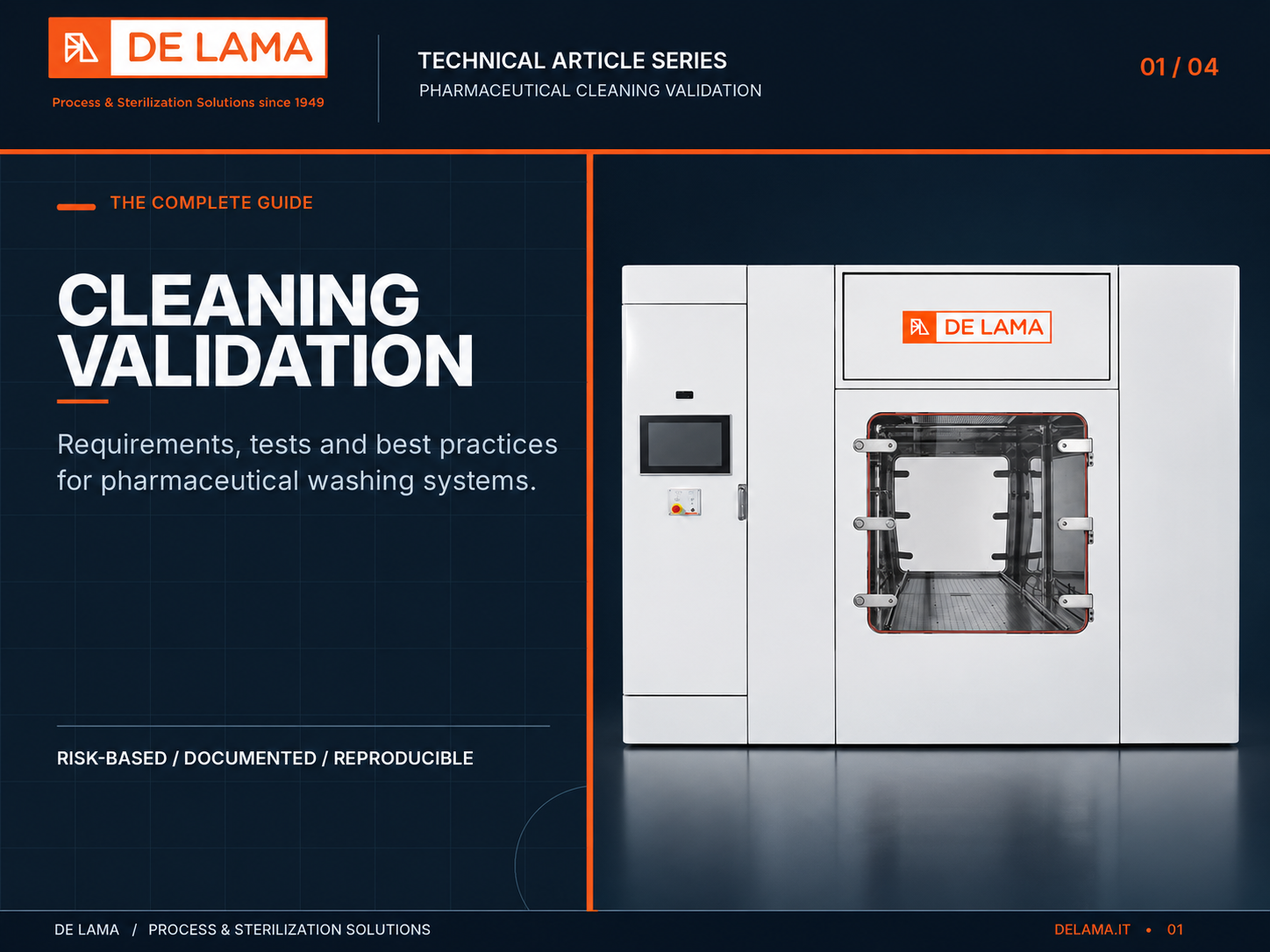
Cleaning Validation for Pharmaceutical Washing Systems: Requirements, Tests and Best Practices
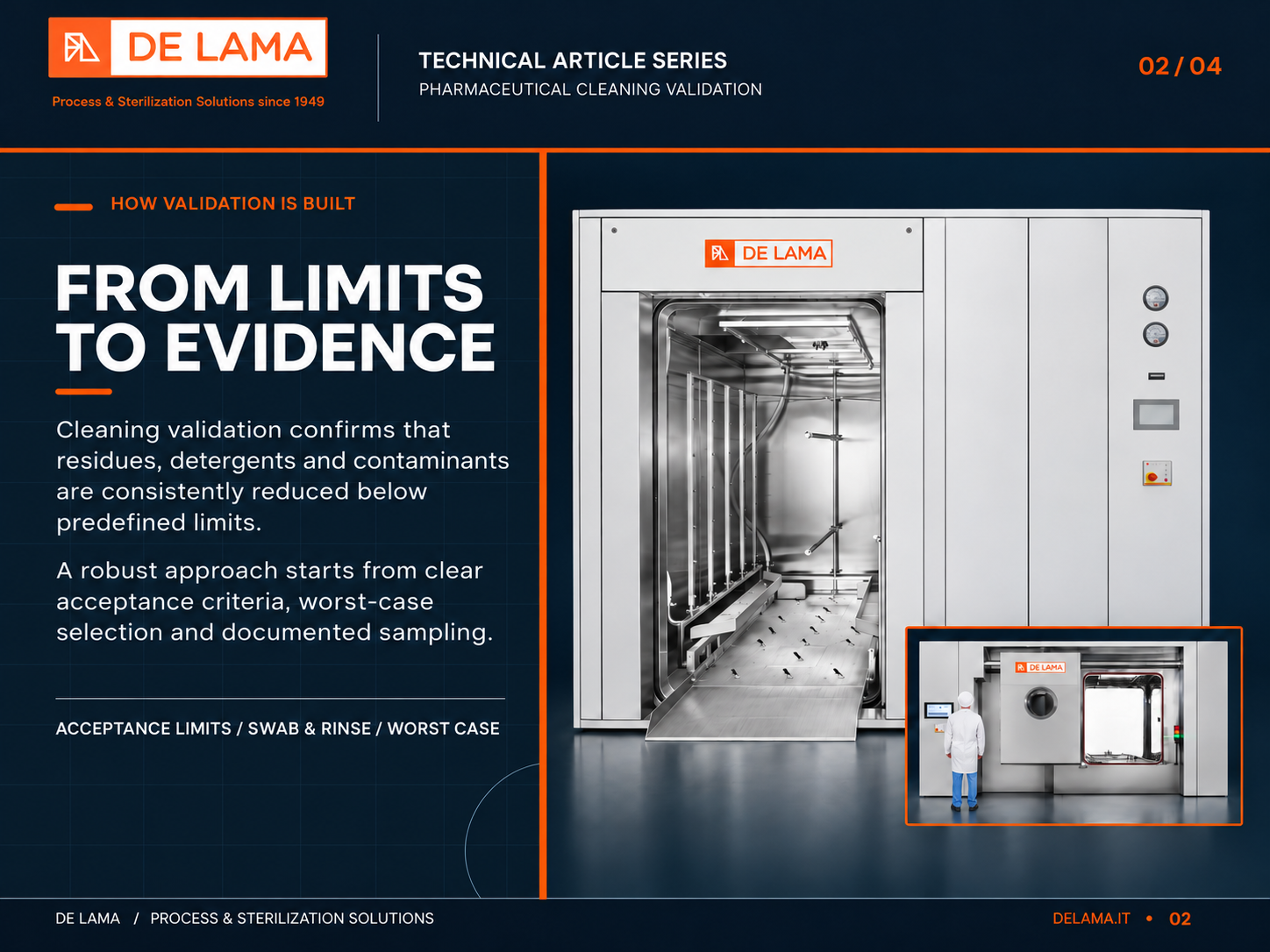
In pharmaceutical manufacturing, every surface that comes into contact with the product can become a route for cross-contamination: active ingredient residues, detergents, microbial contaminants or endotoxins can carry over from one batch to the next if cleaning is not effective and reproducible. Cleaning validation is how a manufacturer demonstrates, with documented data, that its cleaning process reduces residues to predefined levels in a reproducible way.
This guide covers what European and FDA cleaning validation guidance requires, how a validation program is structured, how residue limits are set and why automated washing systems, from clean in place (CIP) to load-based pharmaceutical washers, are an important ally for robust validation.
What Is Cleaning Validation?
Cleaning validation is the set of activities that provides documented evidence that a cleaning procedure, carried out under defined parameters, consistently removes product residues, detergent residues and microbial contamination below acceptance limits set in advance. It is not about a single cleaning event, but about the ability of the process to deliver the same result every time.
Cleaning validation in the pharmaceutical industry has two goals. The first is to protect the patient, preventing traces of one drug from ending up in the next batch of a different product, a particularly serious risk for highly potent, cytotoxic or sensitizing active ingredients. The second is to protect the product, preventing degradation, interactions with detergent residues and microbial contamination. Effective pharmaceutical cleaning validation is therefore a quality requirement, but also a precondition for running multi-product facilities safely and efficiently.
The Regulatory Framework
The main cleaning validation guidelines share the same principles, with different emphases in Europe and the United States.
‣ EU GMP Annex 15 (in force since October 1, 2015), chapter 10: requires cleaning validation for all product-contact equipment and asks manufacturers to consider two hold times: the dirty hold time, the maximum time between end of production and cleaning, and the clean hold time, the maximum time between cleaning and reuse. It also states that visual inspection alone is not normally sufficient and that a “clean and retest until clean” approach is not acceptable. The number of validation runs should be based on risk.
‣ EU GMP Part I, chapters 3 and 5, and the EMA guideline on Health Based Exposure Limits (HBEL): HBELs are exposure limits based on health data. For each active substance, a toxicological assessment sets the PDE (Permitted Daily Exposure), the dose a person could take every day for a lifetime without adverse effects. In multi-product facilities, this value is the starting point for setting residue limits. The 2018 EMA Q&A clarify how to apply it.
‣ FDA: the cGMP requirements are in 21 CFR 211.67, which calls for written procedures for cleaning and maintaining equipment at appropriate intervals, and 21 CFR 211.182 on equipment cleaning and use logs. Among the FDA interpretive references is the inspection guide “Validation of Cleaning Processes” (1993), which focuses mainly on chemical residues.
‣ PIC/S PI 006-4 (effective October 1, 2026): the updated recommendation on qualification and validation, which expands on cleaning validation with a risk-based, lifecycle approach. It is technical guidance, not a new binding regulation.
‣ Other references: ICH Q7 for active pharmaceutical ingredients and ICH Q9(R1) for quality risk management. Computerized systems fall under EU GMP Annex 11 and, where relevant, 21 CFR Part 11.
The Stages of a Cleaning Validation
A cleaning validation program starts from a master plan that defines equipment, products, responsibilities and strategy. Each process to be validated then has its own cleaning validation protocol, which sets the worst cases, sampling locations and methods, analytical methods, acceptance criteria and number of runs. The work closes with a report that documents the results and concludes whether the acceptance criteria have been met.
Cleaning development and worst-case selection
Validation is preceded by cleaning development: the characteristics of the residues (solubility, adhesion, degradation) are studied, the detergent is selected and the critical parameters are defined. A useful model is Sinner’s circle, according to which cleaning effectiveness depends on the balance between chemical action, mechanical action, temperature and time. If one factor is reduced, the others must compensate: a lower temperature, for example, may require a longer time or a different detergent action.
In multi-product facilities, not every possible combination is validated: products and equipment are grouped into families, provided the grouping is justified, and a worst case is identified for each. The choice considers both how hard the residue is to remove and the risk to the patient, and the two do not necessarily coincide: the least soluble product is not always the one with the lowest PDE. Maximum campaign length, the longest dirty hold time and the hardest-to-reach equipment locations also matter. Some cases therefore require more than one worst-case scenario, documented through a risk assessment.
Sampling, analytical methods and acceptance criteria
The two main sampling methods are complementary. Swab sampling collects residue directly from a defined area, often 25 or 100 cm², at the critical locations identified by the risk assessment. The assessment may also include surfaces not in direct product contact, such as gaskets or flanges, where there is a documented risk of residues migrating into the next production. Rinse sampling collects residue from large or inaccessible surfaces, such as piping and vessel interiors. Both require recovery studies, tests that measure how much of the residue the sampling method actually collects.
Analytical methods can be specific, such as high-performance liquid chromatography (HPLC), or non-specific, such as total organic carbon (TOC) and conductivity, which can be used when appropriate to the residue and the matrix. Non-specific methods do not identify a single substance on their own: TOC measures overall organic carbon, conductivity responds to ionic species, and results must be interpreted in light of the cleaning procedure. All methods must be fit for purpose, with sensitivity and a limit of quantitation suited to the acceptance criteria. Visual inspection, bioburden testing and, where relevant, endotoxin testing complete the picture.
What are the acceptance criteria for cleaning validation? The starting point is patient protection: residue carried over into the next product must not expose the patient to a dose above the toxicological threshold. For active ingredients, this threshold is the HBEL, usually expressed as a PDE.
For a given product changeover, the MACO (Maximum Allowable Carry Over) can be estimated as the maximum quantity of residue that may be transferred. A common calculation takes the PDE of the previous product, multiplies it by the minimum batch size of the next product and divides it by the maximum daily dose of the next product. Dividing the MACO by the shared surface area gives a reference for swab or rinse limits.
Acceptance limits and, where used, alert limits are then set from this assessment, taking into account process capability, analytical variability and risk: operating limits can therefore be tighter than the toxicological threshold. Historical criteria such as 1/1000 of the therapeutic dose or 10 ppm can remain as supporting criteria, but they do not replace the toxicological assessment. Surfaces must also be visually clean.
Cleaning Validation and Automated Washing Systems
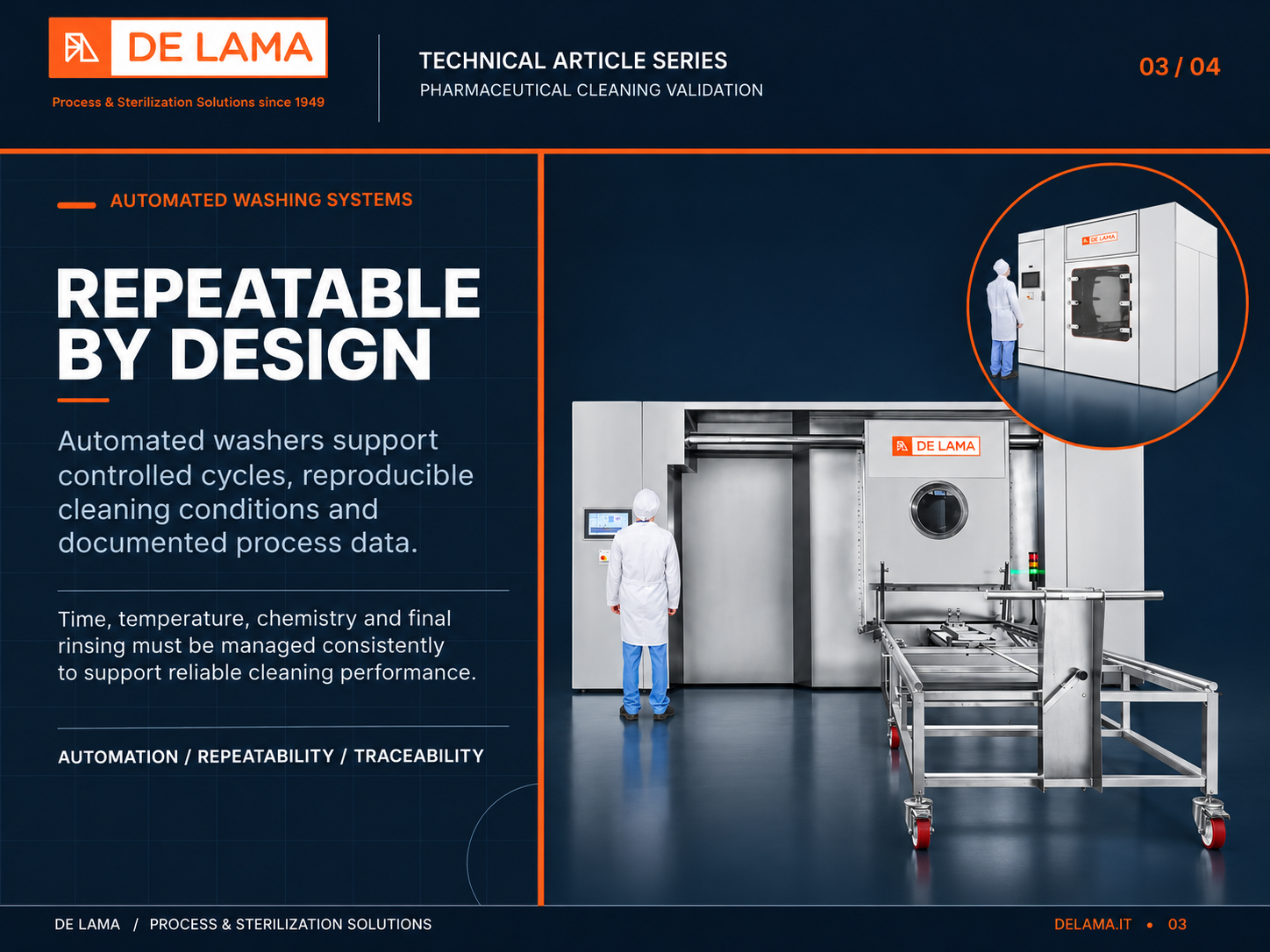
Manual cleaning depends heavily on the operator, which makes it harder to validate and to keep in a validated state. Compared with manual procedures, automated pharmaceutical washing systems reduce operator-induced variability and allow the parameters of every cycle to be controlled and recorded. This supports reproducibility and facilitates cleaning validation, provided the validated operating conditions and load configurations are respected.
CIP/SIP and load-based washers
What is clean in place? Clean in place (CIP) cleans fixed equipment, such as vessels, reactors and piping, without dismantling it: cleaning solutions circulate through the system and reach internal surfaces through spray balls or rotating spray devices. A typical clean in place process follows these CIP cleaning steps:
1. pre-rinse with water to remove loose residues;
2. hot alkaline wash with a detergent solution, the core of CIP cleaning;
3. intermediate rinse;
4. optional acid wash, for example to remove mineral deposits;
5. final rinse with purified water (PW) or water for injections (WFI), often with conductivity monitoring;
6. where required, drying with air.
Critical parameters in CIP cleaning are flow rate, fluid velocity in the piping, temperature, detergent concentration and contact time. Where required, CIP can be followed by SIP (Sterilization In Place), a distinct process whose purpose is to sterilize the equipment, usually with clean steam.
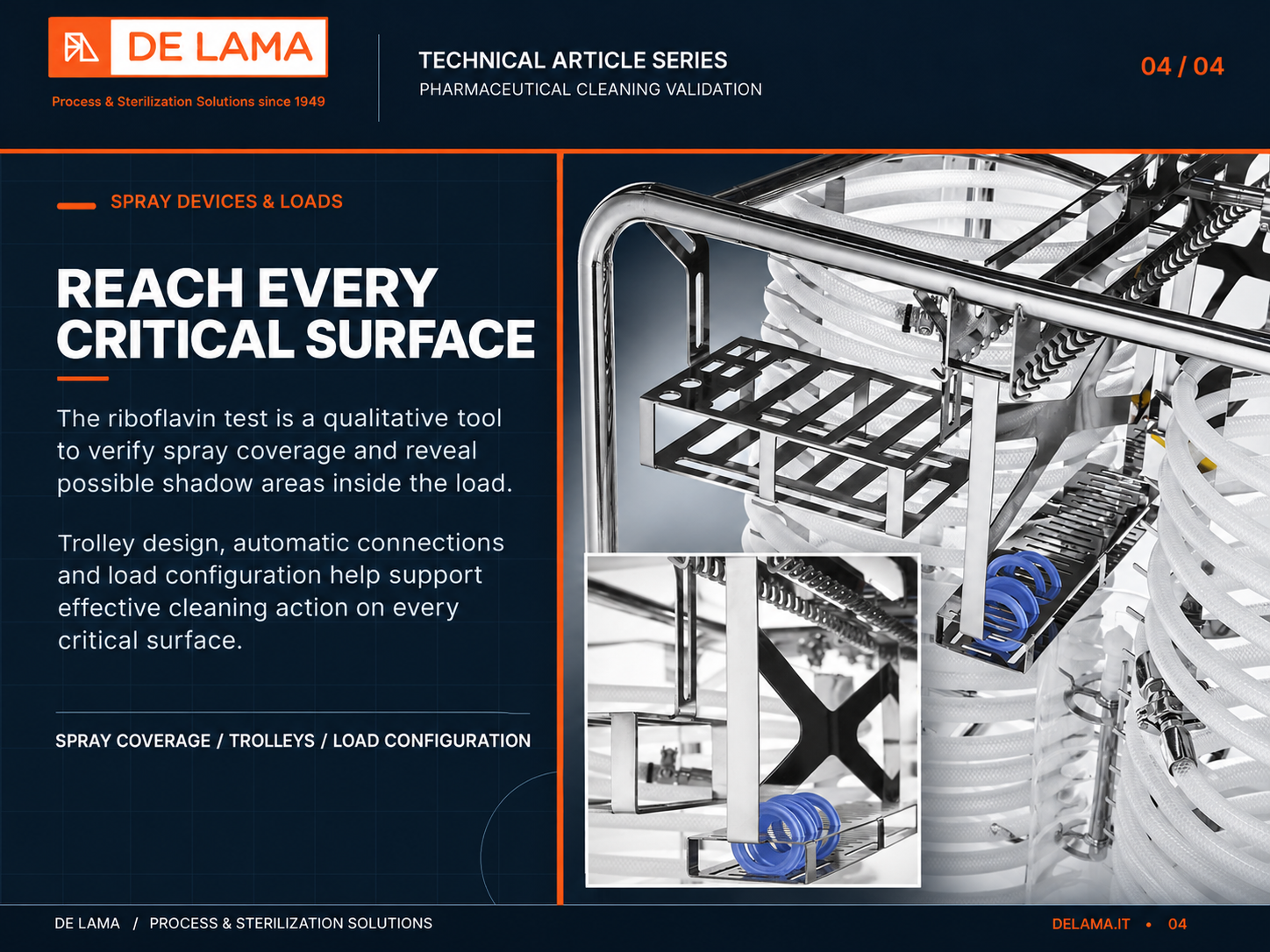
Many removable parts, such as filling line components, machine parts, containers, utensils and glassware, can be washed out of place in a load-based pharmaceutical washer, depending on their geometry and material compatibility. Here too the cycle follows defined phases, from pre-wash and detergent wash through rinses to a final rinse with qualified water and drying, but with one more element to validate: the load configuration. Racks and load carriers designed for each family of parts, with nozzles positioned according to the geometry, ensure that the spray reaches every surface to be cleaned. For the related category of equipment used with medical devices and laboratory items, see our article on washer-disinfectors.
Cycle repeatability, recipes and data integrity
A washing process remains in a validated state when it is run in accordance with approved procedures and with the parameters, or their operating ranges, established during validation. In automated systems this translates into recipes: sets of parameters (times, temperatures, detergent concentration, pressure and flow, water quality, drying) linked to a specific load and protected against unauthorized changes. Identifying the rack and the program reduces the risk of starting the wrong cycle.
Computerized systems used in GMP activities must ensure data integrity according to ALCOA+ principles (data that are attributable, legible, contemporaneous, original and accurate, as well as complete, consistent, enduring and available). They must meet the applicable requirements of EU GMP Annex 11 and, where relevant, 21 CFR Part 11. Access control, records, audit trails and change management are defined according to risk and to how the data are used. In-line monitoring of parameters such as final rinse conductivity, where provided, adds an objective check to every cycle.
The machine itself is qualified through installation, operational and performance qualification (IQ, OQ and PQ), the same sequence described in our article on autoclave validation, preceded by factory and site acceptance tests (FAT and SAT). Qualification applies to the equipment; cleaning effectiveness still has to be demonstrated for the user’s products, loads, procedures and conditions of use.
The riboflavin coverage test for spray devices
How is a riboflavin coverage test performed? The riboflavin test is a qualitative check of whether the rinse liquid reaches and wets the surfaces, under the conditions defined in the protocol. The 2007 VDMA information sheet describes possible ways to perform it, without replacing cleaning validation. A typical sequence is:
1. prepare the fluorescent solution according to the protocol; a commonly used reference value is around 0.2 g/L, usually with riboflavin sodium phosphate, which is more soluble than riboflavin;
2. apply it as a thin, even film to the surfaces to be checked (chamber or vessel walls, racks, load items), confirming under UV light that coverage is complete;
3. run the rinse cycle with the specified flow, pressure and time;
4. inspect the surfaces in darkness with a UV lamp, for example at around 365 nm: residual fluorescence may indicate a coverage or removal issue under the test conditions;
5. correct the causes, such as nozzle position or orientation, rack configuration or part arrangement, and repeat the test.
The test is usually performed during acceptance testing and qualification, and whenever spray devices, racks or load configurations change. It helps identify critical areas in liquid distribution, but it does not on its own demonstrate the removal of real pharmaceutical residues. Riboflavin is poorly soluble in water and its removal depends on test conditions and adhesion to surfaces; experimental work shows that some shadowed areas may go undetected. Results must therefore be interpreted together with swab, rinse and analytical results.
FAQ
How often should cleaning validation be repeated?
There is no fixed deadline. A new validation, full or partial, is needed when something changes that could affect the outcome: a new product that becomes the worst case, a new detergent, changes to the equipment, the washing recipe or the load configuration. Between validations, the validated state is maintained through change control, cycle monitoring and a risk-based periodic review, with scheduled analytical checks where appropriate.
What is the difference between cleaning verification and cleaning validation?
Cleaning verification checks that a specific cleaning operation has met the acceptance criteria. Cleaning validation demonstrates, over several runs and under defined conditions, that the process meets those criteria reproducibly. Verification can accompany validation and continue afterwards when the risk assessment requires it, to maintain a state of control; it is also the only option where validation is not practicable, for example with investigational products.
De Lama Expertise
For over 75 years De Lama has designed equipment for pharmaceutical manufacturing, including load-based washers: industrial cGMP washers and GLP washers for glassware and parts from the DLWM series, designed to facilitate cleaning validation. Cycles control the critical parameters (pressure, flow, temperature, time and detergent concentration), the final rinse can use qualified water, such as purified water (PW) or water for injections (WFI), according to process needs, and drying is controlled and repeatable. Custom racks, with nozzles positioned according to part geometry and automatic water flow connection, and the patented Ultrasoniclean® option for small components with narrow lumens, such as needles, complete the range, together with the combined DLOV/W washer and sterilizer units.
The software is developed according to GAMP principles, the ISPE guidance for GMP computerized systems, with full data traceability, and every system comes with a qualification and validation program. Contact De Lama to define the washing system best suited to your processes.
Do you need some more information? Let us assist you and answer all your questions.