How Does an Autoclave Work? Steam Sterilization Explained
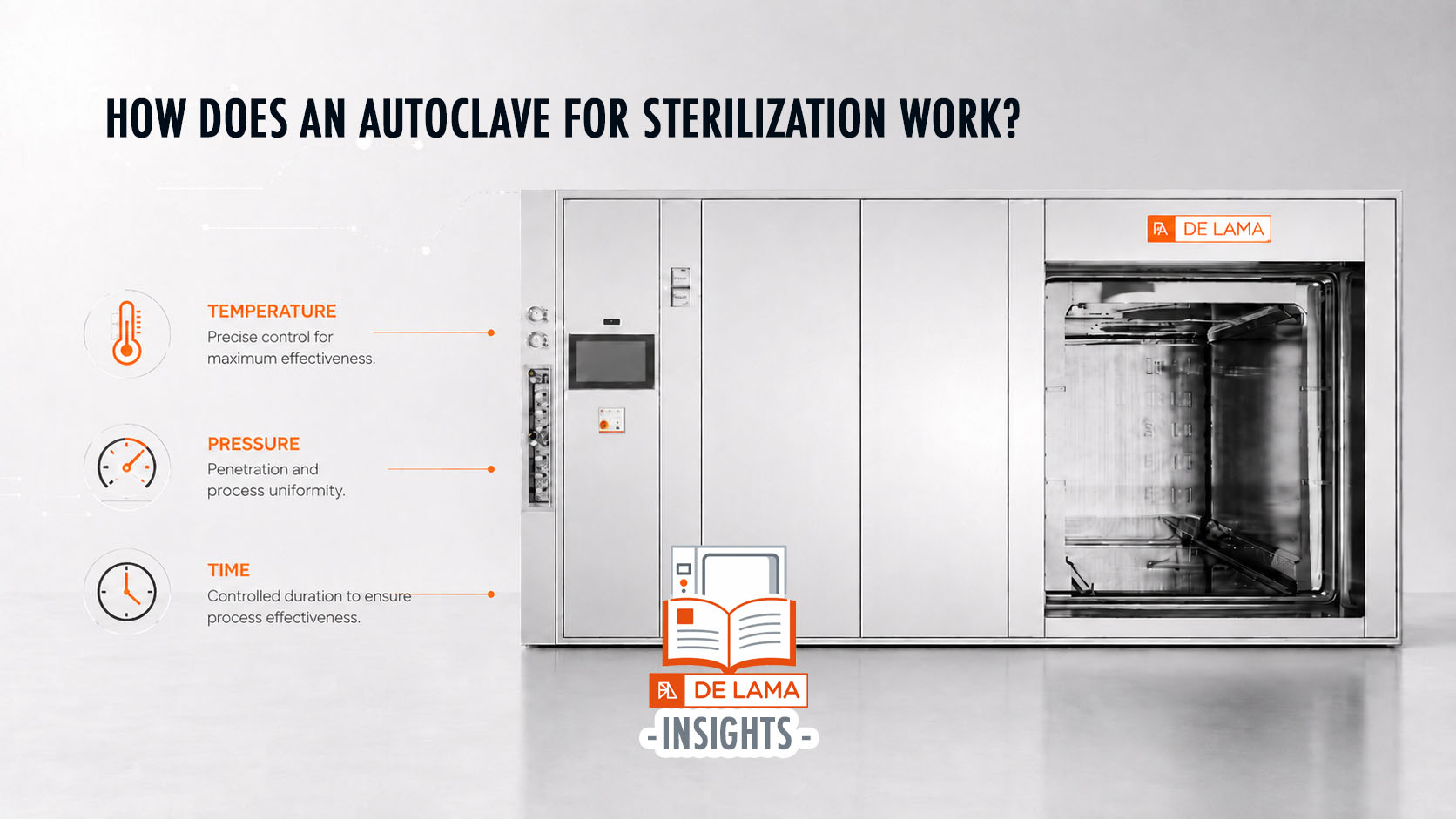
Understanding how an autoclave works comes down to four fundamental elements: the sterilizing agent, temperature, pressure and exposure time. This balance is the basis of most industrial sterilization in the pharmaceutical, medical, biotechnology and laboratory sectors.
In this article we look at what an autoclave is, what it does, how its mechanism works step by step, which parameters determine its effectiveness, how long a cycle lasts and what the main industrial applications are.
What is an autoclave and what does it do?
To define what an autoclave is, we can start from a dictionary sense of the word: a type of hermetic closure for vessels, or more generally for environments held at a pressure higher than the surrounding atmosphere, including the door or hatch that ensures the hermetic seal.
When we talk more specifically about a sterilization autoclave, we start from its function: it is an autoclave that uses a pressure vessel to sterilize materials, instruments, products or components, removing microbial life down to the required sterility level, including the most resistant bacterial spores.
When people refer to autoclave sterilizers they normally think of steam machines, where the combination of pressure and temperature makes the process far more effective than simple boiling. At atmospheric pressure water boils at 100 °C, a temperature that may not be enough to guarantee, within industrially acceptable and validatable times, the inactivation of the most resistant bacterial spores. By increasing the pressure inside the chamber, the saturation temperature of the steam also rises.
The physical principle is that of saturated steam. At around 1 bar gauge, steam reaches approximately 121 °C, while at around 2 bar gauge it can reach about 134 °C. These values underpin many autoclave sterilization cycles used in the pharmaceutical, medical and laboratory industries.
Saturated steam transfers heat to the load through condensation. When it meets a colder surface, it condenses and releases a large amount of latent heat, transferring energy quickly and efficiently. For this reason, in a sterilization autoclave, what matters is not only the nominal temperature reached in the chamber, but also steam quality, air removal, penetration into the load and the maintenance of process conditions for the required time.
As for the question “what does an autoclave do?“, the answer depends on the application. In the pharmaceutical, medical and laboratory fields, an autoclave serves to sterilize instruments, containers, process machine parts, culture media, medical devices, filters, solutions, packaging materials and other products, provided they are compatible with steam, heat and controlled pressure.
De Lama’s saturated steam sterilizers are designed to guarantee repeatability, validatability and compliance with the requirements of regulated sectors, particularly pharmaceutical and medical.
In any case, the saturated steam sterilization autoclave is not the only sterilization autoclave. Other machines use pressure vessels for sterilization purposes too, such as EtO (Ethylene Oxide) autoclaves, where sterilization occurs through the chemical action of the sterilizing gas, or superheated water autoclaves, where sterilization occurs through heat transmission, generated by the hot water onto the product.
To define in technical terms what is meant by “pressure vessel”, we can refer to the various regulations.
When is an autoclave a pressure vessel? Regulatory framework
From a regulatory standpoint, an industrial autoclave can be considered pressure equipment whenever it operates with internal pressure above the defined limits, regardless of the sterilizing agent used: saturated steam, air-steam mixture, superheated water, ethylene oxide or other process fluids. In Europe, the main reference is the Pressure Equipment Directive (PED) 2014/68/EU, applicable to pressure equipment with a maximum allowable pressure PS greater than 0.5 bar (gauge).
For the technical design of unfired pressure vessels, one European reference standard is the EN 13445 series.
In the United States, the main reference for pressure vessels is the ASME Boiler and Pressure Vessel Code, Section VIII; for equipment intended for the pharmaceutical, bioprocessing and sterile medical device sectors, the ASME BPE standard is also central, considered by many companies a fundamental requirement for hygienic design, materials, surface finishes, welds, cleanability, sterilizability and build quality of parts in contact with critical products, fluids or processes. In the United Kingdom, the Pressure Equipment (Safety) Regulations 2016 apply and, for operation, the Pressure Systems Safety Regulations 2000.
In short, what makes an autoclave a pressure vessel is not only the sterilization technology, but the combination of maximum allowable pressure, volume, process fluid, construction configuration and the application requirements of the target sector.
Autoclave or sterilizer? An important technical distinction
In everyday language, many people use “autoclave” and “sterilizer” as synonyms. Technically, however, the two terms are not perfectly equivalent.
In the strict sense, an autoclave is a pressure vessel. It is therefore a machine that operates at pressures above atmospheric and that, for this reason, is subject to the regulations and authorizations required for pressure equipment.
A sterilizer, on the other hand, is more generally a system designed to achieve sterilization. Some sterilizers are autoclaves, because they work under pressure. Others are not pressure vessels.
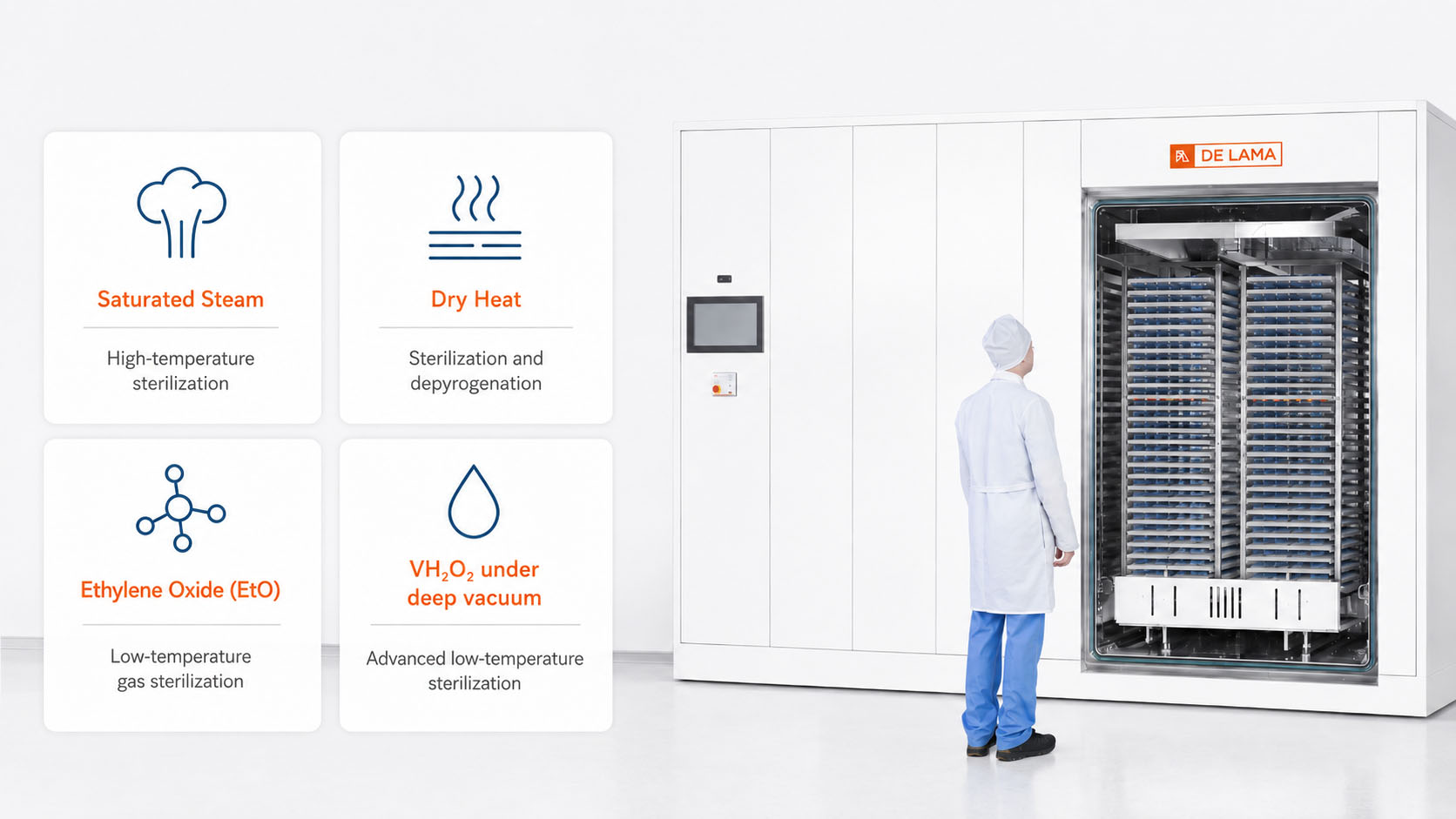
The practical consequence is important: if the question “what is an autoclave” is asked in a strictly technical sense, the answer concerns pressure machines. If, instead, “autoclave” is used generically to mean a sterilization system, then it is necessary to distinguish between different technologies: saturated steam, air-steam mixture, superheated water, dry heat, ethylene oxide and vaporized hydrogen peroxide.
How does an autoclave work step by step?
How an autoclave works depends on the technology used. Below we describe the saturated steam autoclave cycle, the most common in industry; EtO or superheated water autoclaves, for example, follow partly different phases. The steam cycle unfolds in sequential, controlled phases. The goal is to bring every point of the load to the required temperature and pressure conditions for the necessary time, ensuring that steam reaches every surface to be sterilized. Each phase is controlled by the machine’s automation system, normally via PLC and supervisory software, with continuous recording of the critical parameters.
Chamber loading and sealing
The cycle begins with loading the material into the chamber, followed by closing and securing the door. In industrial autoclaves, safety interlocks prevent the cycle from starting if the chamber is not correctly sealed, and prevent the door from opening while the chamber is under pressure or temperature. Industrial autoclaves are rarely standard machines: they are often custom-engineered systems, integrated into the production process, equipped with advanced control systems, cycle recipes, data recording, alarms and validation logic.
Air removal and steam injection
One of the most important points in how an autoclave works is the removal of air from the chamber. Residual air is a poor heat conductor and can prevent steam from properly reaching some areas of the load, creating cold spots and the risk of incomplete sterilization.
For this reason, modern autoclaves use fractionated vacuum (pre-vacuum) cycles, which alternate vacuum pulses and steam injection. This sequence makes it possible to evacuate air even from porous loads, hollow bodies, tubing, packaged materials or complex configurations. In gravity displacement cycles, which are less aggressive, the heavier air is pushed downward and displaced by the incoming steam; these cycles can suit simple loads but do not offer the same steam penetration in complex loads.
Steam is generated by a dedicated steam generator or by a centralized network, and is injected into the chamber while the system regulates the minimum and maximum pressure according to the selected cycle. The autoclave pumps, vacuum systems, valves, sensors and control instruments manage the flows and keep parameters within tight tolerances. The vacuum unit, often based on liquid-ring pumps or combined systems with ejectors, plays a key role: it extracts air before sterilization and contributes to load drying afterwards.
The effectiveness of air removal is verified with specific tests. The Bowie-Dick test highlights any steam penetration problems or residual air, while the vacuum leak test verifies that the chamber correctly holds vacuum and that there is no infiltration from outside.
Sterilization phase under pressure
Once temperature and pressure set-points are reached, the exposure phase begins, also called the plateau. During this phase, the load is held under sterilization conditions for the time needed to guarantee the planned microbial reduction.
A particular case concerns the sterilization of liquids in closed containers, such as vials, bottles, bags or large-volume parenterals. During heating, the internal pressure of the liquid and container rises and, if not properly controlled, can cause deformation, leaks or breakage. For this reason a controlled counter-pressure is applied, often using compressed air or an air-steam mixture, to balance the internal pressure during heating and cooling. This is one of the reasons why, alongside pure saturated steam, technologies such as air-steam mixture sterilizers and superheated water sterilizers exist. Each pressure, temperature and cooling profile is designed to protect the product while ensuring the microbiological effectiveness of the process.
Drying and unloading
The exposure phase does not coincide with the total cycle duration. After it come pressure release, optional drying, cooling and load stabilization, followed by final unloading. For many packaged or porous materials, drying is a critical phase: residual moisture can compromise the sterility of the material after the cycle, encourage subsequent contamination or make the packaging unsuitable for storage. For this reason, in industrial autoclaves, vacuum drying is designed according to the load, the packaging and the process requirements.
Precisely because of how the chamber works, subjected to repeated vacuum, pressure and thermal cycles, build quality becomes decisive. The chambers of industrial autoclaves must maintain tightness, precision and reliability over time, even after thousands of cycles. In this sense, structural robustness is a fundamental element for process safety and for the durability of the investment.
Why is steam used in autoclave sterilization?
Steam is the preferred sterilizing agent because it combines high effectiveness, low cost and full validatability. The reason lies in the physics of condensation: when saturated steam meets the cooler load, it condenses and releases a large amount of latent heat, transferring energy far more efficiently than hot air at the same temperature. Moist heat also denatures microbial proteins much faster than dry heat, which is why steam cycles work at lower temperatures and shorter times than dry-heat processes.
This effectiveness is measured with precise parameters. The D-value (decimal reduction time) is the time needed, at a given temperature, to reduce the microbial population by 90%, that is by one log. The z-value indicates by how many degrees the temperature must rise to reduce the D-value by a factor of ten. The most widely used parameter in steam sterilization is F₀, the equivalent sterilization time expressed in minutes at 121.1 °C with a z-value of 10 °C; F₀ integrates the lethal effect of the whole cycle and allows cycles with different thermal profiles to be compared. For many pharmaceutical loads a minimum F₀ in the order of 8-15 minutes is required, although the correct value must be defined based on the product, the bioburden, the sterilization strategy and regulatory requirements.
The final objective is the SAL (Sterility Assurance Level). For many sterile products a SAL of 10⁻⁶ is required, corresponding to a theoretical probability of no more than one non-sterile unit in a million. Achieving and documenting these values, through a validation path that includes IQ, OQ, PQ, process validation and thermal mapping of chamber and load to identify the cold spot, is what distinguishes a validated industrial sterilization from a simple heat treatment. The reference framework includes the Pharmacopoeias, the ISO 17665 series for steam sterilization and, for sterile manufacturing, the new Annex 1 of EU GMP. De Lama supports the supply of its systems with validation services and FAT and SAT testing.
How long does an autoclave cycle take?
There is no single duration. A complete cycle can last from around 20-30 minutes for simple loads to over an hour for complex, bulky or hard-to-dry loads. The actual exposure phase may be, for example, 15-20 minutes at 121 °C or 3-4 minutes at 134 °C, but these values are only part of the cycle: air evacuation, heating, reaching the cold spot, pressure release, cooling, drying and the safety checks before opening must all be added. The total duration depends on load mass, geometry, packaging, the presence of liquids, vacuum-system capacity, cycle type and process validation requirements. This also answers a common question, “why is autoclaving often done for 15 minutes?”: 15 minutes at 121 °C is a classic reference exposure that, for many loads, delivers the required F₀, although it is not a universal rule.
Types of autoclaves used in industry and laboratories
There are several types of autoclaves and industrial sterilizers, chosen according to the product to be treated, the packaging and the microbiological requirements.
Saturated steam autoclaves are the standard for heat-resistant materials compatible with steam, and are used for instruments, components, machine parts, laboratory materials and many industrial loads that tolerate temperature and moisture. Air-steam mixture sterilizers combine steam and compressed air to better handle products in closed or deformable containers, where the pressure differential between the inside and outside of the container must be controlled. Superheated water sterilizers use water above 100 °C under controlled pressure and are particularly suited to liquids, solutions and products in sealed containers such as vials, bottles, bags or large-volume parenterals.
Dry-heat ovens for sterilization and depyrogenation work at higher temperatures and are used above all for materials such as glassware and metal components, or products that also require depyrogenation. Ethylene oxide (EtO) sterilizers are used for heat-sensitive products compatible with this sterilizing gas. Finally, vaporized hydrogen peroxide sterilizers HyPerPure® represent a low-temperature technology for delicate products, particularly medical devices and materials that cannot be treated with traditional saturated steam. Today this technology is also gaining ground for products traditionally treated with saturated steam, because it enables energy savings of around 70% (with a corresponding 70% reduction in CO₂ emissions) and the total elimination of water use.
Beyond bench-top laboratory autoclaves, designed for smaller loads, industrial autoclaves must manage large loads, repeatable cycles, data traceability, qualifications, operator safety and integration with production lines. They can be connected to a dedicated steam generator or to a plant steam network, installed in pass-through versions between areas of different classification, or integrated into complex production layouts.
What should never be autoclaved?
Referring to steam autoclaves, not everything can be processed. Saturated steam is extremely effective, but it requires the product to be compatible with heat, moisture and pressure.
In general, the following should not be processed in a steam autoclave: heat-sensitive materials that degrade with heat; oily substances, which steam cannot penetrate properly; powders not compatible with moisture and condensation; some plastics with a low melting point; electronic components; devices assembled with moisture-sensitive materials; products in packaging unsuitable for steam; and materials at risk of deformation, corrosion or loss of performance.
For these cases, alternative technologies must be evaluated. One of the areas where De Lama has developed dedicated solutions is the treatment of heat-sensitive medical devices, where the choice of process is decisive in preserving the integrity, functionality and safety of the product. The main alternatives to steam are Ethylene Oxide (EtO), a low-temperature sterilizing gas historically used for many single-use medical devices and heat-sensitive materials, and vaporized hydrogen peroxide (VH₂O₂), a modern low-temperature technology particularly suited to delicate products, on which De Lama has developed its proprietary HyPerPure® technology operating under high vacuum and zero air.
Low-temperature, high-precision autoclaves are also used for products such as blood derivatives or hyaluronic acid powders, which, besides being sensitive to high temperatures, must not come into contact with moisture.
Autoclave sterilization in pharma, laboratories and medical devices
The sterilization autoclave is a cross-cutting technology across many industrial sectors. In the pharmaceutical industry it is used to sterilize injectable solutions, vials, process components, machine parts, instruments and materials destined for sterile environments. In the medical sector it can be used for devices and instruments compatible with steam, while in laboratories and research centers it is used for glassware, culture media, contaminated materials and reusable instruments.
Steam sterilization remains a benchmark technology for many industrial processes thanks to its effectiveness, reliability and long validation history. However, the sector is evolving rapidly toward more sustainable, flexible solutions compatible with complex or heat-sensitive products. Dry heat works at higher temperatures (typically 160-250 °C) and acts by oxidation, and is especially valuable because it can both sterilize and depyrogenate, reducing or eliminating bacterial endotoxins on suitable glassware and components. Vaporized hydrogen peroxide acts by chemical oxidation at low temperature and, as noted above, is gaining ground even for non-heat-sensitive products thanks to its significant savings and reduced environmental impact (-70% energy, -70% CO₂ emissions, -100% water).
In this scenario sits De Lama’s HyPerPure® technology. In addition, integration with isolators, combined systems (several sterilization processes in a single machine, or combination with other processes such as washing or decontamination) and continuous sterilization processes such as De Lama’s ZeroStop® represent an increasingly important frontier for high-speed production lines and for full compliance with modern contamination control requirements.
Conclusion
Understanding how an autoclave works means understanding the balance between the sterilizing agent (usually steam), temperature, pressure, time and process quality. In an industrial context, the autoclave is not just a chamber that heats and pressurizes: it is a complex system, engineered to guarantee safe, repeatable, documented and validatable sterilization.
For companies in the pharmaceutical, medical and laboratory sectors, choosing the most suitable autoclave or sterilization technology is a strategic decision. Every product has specific requirements: some tolerate saturated steam perfectly, others require air-steam mixture, superheated water, dry heat, ethylene oxide or vaporized hydrogen peroxide.
De Lama has designed and manufactured custom industrial sterilizers and autoclaves for over 75 years, offering a complete portfolio of industrial sterilization technologies. To find the most suitable solution for your process, contact our specialists.
Do you need some more information? Let us assist you and answer all your questions.